Titania 🔒 Members
Shakespeare. From A Midsummer Night's Dream, William Shakespeare (died 1616). Queen of the fairies, proud and powerful, who quarrels with Oberon over a changeling boy and falls under an enchantment that makes her love a man with an ass's head.
Care note: S: all ages framing, fully clothed, regal not glamour.
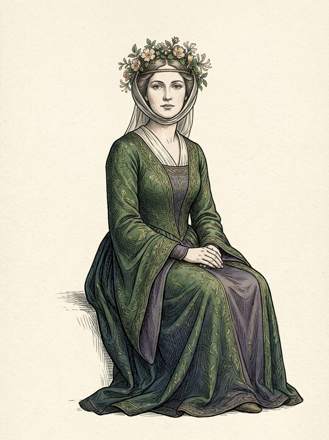
Age and build
The book is silent here, so we keep this plain and neutral.
Face and hair
The book is silent here, so we keep this plain and neutral.
Dress
The book is silent here, so we keep this plain and neutral.
Voice and speech
speaks in elaborate, poetic language with extended metaphors
“Therefore the winds, piping to us in vain, As in revenge, have suck’d up from the sea Contagious fogs” (A Midsummer Nights Dream, part 3)
uses formal address and courtly phrasing
“I pray thee, gentle mortal, sing again. Mine ear is much enamour’d of thy note” (A Midsummer Nights Dream, part 5)
Signature words
proud
“Ill met by moonlight, proud Titania” (A Midsummer Nights Dream, part 3)
jealous (applied to Oberon)
“What, jealous Oberon” (A Midsummer Nights Dream, part 3)
spirit of no common rate
“I am a spirit of no common rate” (A Midsummer Nights Dream, part 5)
love (repeated declaration)
“I do love thee: therefore, go with me” (A Midsummer Nights Dream, part 5)
dote
“O, how I love thee! How I dote on thee” (A Midsummer Nights Dream, part 7)
Gait and mannerisms
leads her train of fairies with authority
“Enter Titania with her Train” (A Midsummer Nights Dream, part 4)
commands fairies to perform tasks and sing
“Come, now a roundel and a fairy song; Then for the third part of a minute, hence; Some to kill cankers in the musk-rose buds” (A Midsummer Nights Dream, part 4)
physically affectionate when enchanted
“While I thy amiable cheeks do coy, And stick musk-roses in thy sleek smooth head, And kiss thy fair large ears, my gentle joy” (A Midsummer Nights Dream, part 7)
Strengths
eloquent and commanding speaker
“These are the forgeries of jealousy: And never, since the middle summer’s spring, Met we on hill, in dale, forest, or mead” (A Midsummer Nights Dream, part 3)
powerful enough to refuse Oberon's demands
“Set your heart at rest; The fairyland buys not the child of me” (A Midsummer Nights Dream, part 3)
capable of bestowing magical gifts and protection
“I’ll give thee fairies to attend on thee; And they shall fetch thee jewels from the deep” (A Midsummer Nights Dream, part 5)
Flaws
proud and defiant toward Oberon
“What, jealous Oberon! Fairies, skip hence; I have forsworn his bed and company” (A Midsummer Nights Dream, part 3)
susceptible to magical enchantment
“Titania wak’d, and straightway lov’d an ass” (A Midsummer Nights Dream, part 6)
becomes obsessive and irrational when enchanted
“So is mine eye enthrallèd to thy shape; And thy fair virtue’s force perforce doth move me, On the first view, to say, to swear, I love thee” (A Midsummer Nights Dream, part 5)
Traits
regal and dignified
“I am a spirit of no common rate. The summer still doth tend upon my state” (A Midsummer Nights Dream, part 5)
maternal and protective of the changeling boy
“But she, being mortal, of that boy did die; And for her sake do I rear up her boy, And for her sake I will not part with him” (A Midsummer Nights Dream, part 3)
passionate and intense in emotion
“O, how I love thee! How I dote on thee” (A Midsummer Nights Dream, part 7)
aware of her power over nature
“And this same progeny of evils comes From our debate, from our dissension; We are their parents and original” (A Midsummer Nights Dream, part 3)
Lines in their own words
defiant refusal to Oberon
“What, jealous Oberon! Fairies, skip hence; I have forsworn his bed and company” (A Midsummer Nights Dream, part 3)
declaration of love when enchanted
“I pray thee, gentle mortal, sing again. Mine ear is much enamour’d of thy note” (A Midsummer Nights Dream, part 5)
commanding her fairies
“Come, now a roundel and a fairy song; Then for the third part of a minute, hence” (A Midsummer Nights Dream, part 4)
expressing horror at her enchantment
“My Oberon, what visions have I seen! Methought I was enamour’d of an ass” (A Midsummer Nights Dream, part 7)
reconciliation with Oberon
“Come, my lord, and in our flight, Tell me how it came this night That I sleeping here was found” (A Midsummer Nights Dream, part 7)
Reference sheet
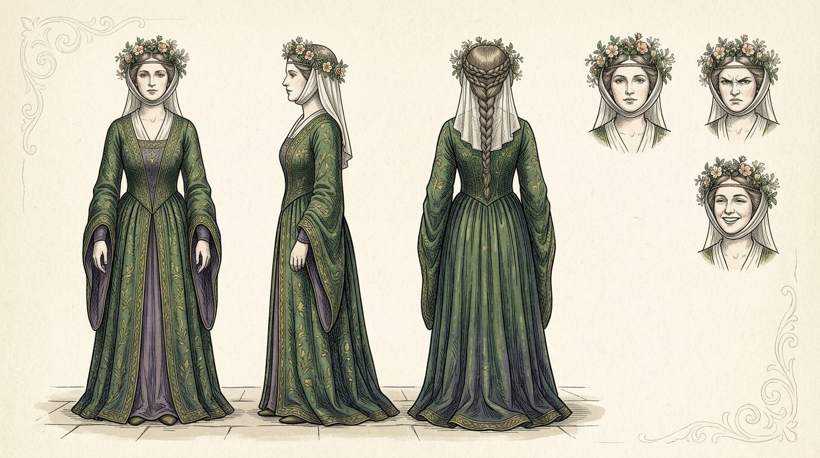
Film looks we will not copy
- Michelle Pfeiffer 1999 film look
- Judi Dench stage look
- Victorian fairy painting poses with bare skin
- Tinker Bell or any Disney fairy
- Butterfly wings from later fairy art
Always book accurate. Every quote above was checked word for word against our stored copy of the text. Pictures are made with AI from the book's own description and checked by hand for film looks.