The Time Traveller
Science fiction. From The Time Machine, H.G. Wells (1895). A brilliant but eccentric inventor who builds a machine to travel through time and journeys to the distant future, discovering a world far stranger than he anticipated.
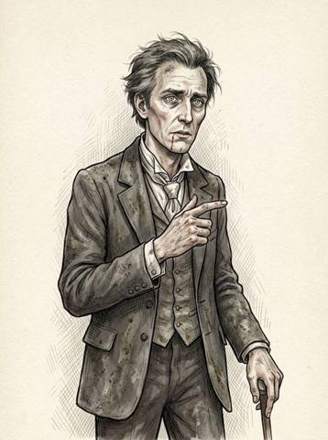
Age and build
Lean build with slender fingers
“marking the points with a lean forefinger” (The Time Machine, chapter 1)
Not a young man at the time of his descent into the well
“I suppose I covered the whole distance from the hill crest to the little lawn, two miles perhaps, in ten minutes. And I am not a young man” (The Time Machine, chapter 7)
Face and hair
Grey eyes that shine and twinkle
“His grey eyes shone and twinkled, and his usually pale face was flushed and animated” (The Time Machine, chapter 1)
Pale complexion that becomes flushed when animated
“His grey eyes shone and twinkled, and his usually pale face was flushed and animated” (The Time Machine, chapter 1)
Haggard and drawn expression upon return from the future
“His face was ghastly pale; his chin had a brown cut on it—a cut half-healed; his expression was haggard and drawn, as by intense suffering” (The Time Machine, chapter 3)
Hair appears greyer after time travel, either from dust or actual fading
“his hair disordered, and as it seemed to me greyer—either with dust and dirt or because its colour had actually faded” (The Time Machine, chapter 3)
Dress
Dingy nineteenth-century garments
“I, dressed in dingy nineteenth-century garments, looking grotesque enough, garlanded with flowers” (The Time Machine, chapter 5)
Ordinary evening clothes when returning to dinner
“He was dressed in ordinary evening clothes, and nothing save his haggard look remained of the change that had startled me” (The Time Machine, chapter 3)
Voice and speech
Voice too harsh and deep for the delicate future people
“It came into my head, oddly enough, that my voice was too harsh and deep for them” (The Time Machine, chapter 5)
Speaks with faltering articulation when exhausted
“Don’t let me disturb you,” he said, with a certain faltering articulation” (The Time Machine, chapter 3)
Speaks like a weary man at first, then becomes more animated
“He sat back in his chair at first, and spoke like a weary man. Afterwards he got more animated” (The Time Machine, chapter 3)
Signature words
Frequently uses 'I' and personal pronouns in exposition
“I told some of you last Thursday of the principles of the Time Machine” (The Time Machine, chapter 4)
Uses 'you' to address and engage his audience
“You must follow me carefully. I shall have to controvert one or two ideas that are almost universally accepted” (The Time Machine, chapter 1)
Employs 'suppose' when positing hypothetical scenarios
“Suppose the worst?’ I said. ‘Suppose the machine altogether lost—perhaps destroyed” (The Time Machine, chapter 7)
Uses 'I thought' when reflecting on observations
“I thought of the flickering pillars and of my theory of an underground ventilation” (The Time Machine, chapter 8)
Says 'I said to myself' when reasoning internally
“I said to myself, ‘You are in for it now” (The Time Machine, chapter 9)
Gait and mannerisms
Walks with a limp like a footsore tramp upon return
“He walked with just such a limp as I have seen in footsore tramps” (The Time Machine, chapter 3)
Soft padding sound of his footfall
“Again I remarked his lameness and the soft padding sound of his footfall” (The Time Machine, chapter 3)
Hands deep in trousers pockets when walking
“still smiling faintly, and with his hands deep in his trousers pockets, he walked slowly out of the room” (The Time Machine, chapter 1)
Rests elbows on table and presses hands together when explaining
“resting his elbows upon the table and pressing his hands together above the apparatus” (The Time Machine, chapter 2)
Strengths
Brilliant theoretical mind capable of conceiving time travel
“Long ago I had a vague inkling of a machine” (The Time Machine, chapter 1)
Capable of sustained intellectual work over years
“I could work at a problem for years, but to wait inactive for twenty-four hours—that is another matter” (The Time Machine, chapter 7)
Physically capable of swimming and rescuing others
“I hurriedly slipped off my clothes, and, wading in at a point lower down, I caught the poor mite and drew her safe to land” (The Time Machine, chapter 8)
Able to climb despite physical exhaustion and fear
“I disengaged myself from the clutches of the Morlocks, and was speedily clambering up the shaft” (The Time Machine, chapter 9)
Capable of rational analysis and logical deduction
“I could reason with myself. ‘Suppose the worst?’ I said” (The Time Machine, chapter 7)
Flaws
Overconfident in his initial theories about the future
“Very simple was my explanation, and plausible enough—as most wrong theories are” (The Time Machine, chapter 6)
Leaves the Time Machine unguarded and unattended
“I cursed aloud, as I ran, at my confident folly in leaving the machine” (The Time Machine, chapter 7)
Prone to panic and emotional outbursts
“I must have raved to and fro, screaming and crying upon God and Fate” (The Time Machine, chapter 7)
Impatient and unable to wait passively
“I am too Occidental for a long vigil. I could work at a problem for years, but to wait inactive for twenty-four hours—that is another matter” (The Time Machine, chapter 7)
Struggles to understand cultures and peoples different from himself
“I had no convenient cicerone in the pattern of the Utopian books. My explanation may be absolutely wrong” (The Time Machine, chapter 8)
Unprepared and poorly equipped for his journey
“I had come without arms, without medicine, without anything to smoke—at times I missed tobacco frightfully!—even without enough matches” (The Time Machine, chapter 9)
Traits
Intellectually curious and driven to understand
“my curiosity regarding the Palace of Green Porcelain was a piece of self-deception, to enable me to shirk, by another day, an experience I dreaded” (The Time Machine, chapter 9)
Capable of genuine affection and tenderness
“the little doll of a creature presently gave my return to the neighbourhood of the White Sphinx almost the feeling of coming home” (The Time Machine, chapter 8)
Observant and detail-oriented in his observations
“I was continually meeting more of these men of the future, who would follow me a little distance, chatter and laugh about me” (The Time Machine, chapter 6)
Capable of dark humour even in dire circumstances
“I had made myself the most complicated and the most hopeless trap that ever a man devised. Although it was at my own expense, I could not help myself. I laughed aloud” (The Time Machine, chapter 7)
Possesses natural courage despite fear
“But I said to myself, ‘You are in for it now,’ and, feeling my way along the tunnel, I found the noise of machinery grow louder” (The Time Machine, chapter 9)
Lines in their own words
Challenging conventional wisdom
“You must follow me carefully. I shall have to controvert one or two ideas that are almost universally accepted” (The Time Machine, chapter 1)
Defending his theory against scepticism
“Why not?” said the Time Traveller” (The Time Machine, chapter 1)
Expressing wonder at the future world
“Fine hospitality,’ said I, ‘to a man who has travelled innumerable years to see you” (The Time Machine, chapter 4)
Showing affection for Weena
“Good-bye, little Weena,’ I said, kissing her” (The Time Machine, chapter 9)
Expressing his predicament with dark irony
“I had made myself the most complicated and the most hopeless trap that ever a man devised” (The Time Machine, chapter 7)
Demanding sustenance after his ordeal
“Where’s my mutton?” he said. “What a treat it is to stick a fork into meat again” (The Time Machine, chapter 3)
Reference sheet
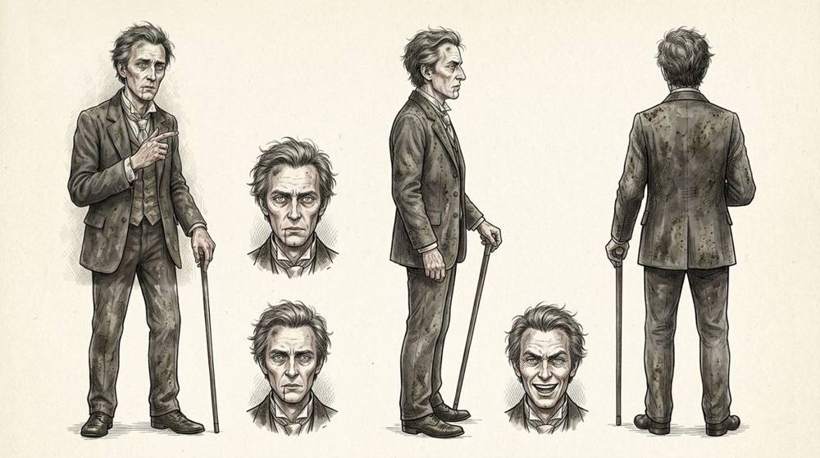
Film looks we will not copy
- The 1960 film: Rod Taylor and the sled shaped machine with a big spinning dish
- The 2002 film: Guy Pearce, the name Alexander Hartdegen
- Steampunk goggles and brass gadgets as a style
- Any link to H.G. Wells as the hero
Every quote above was checked word for word against our stored copy of the text. Pictures are made with AI from the book's own description and checked by hand for film looks.