Thor 🔒 Members
Gods and heroes. From The Poetic Edda, Henry Adams Bellows translation (1923), and The Younger Edda, R.B. Anderson translation (1880). Thor, son of Odin and Jorth, is the strongest of all gods and the thunder-god who defends Asgard against giants and monsters.
Care note: T: Marvel holds trade marks in its Thor designs. We draw only from the Eddas. Bellows died 1939, Anderson died 1936.
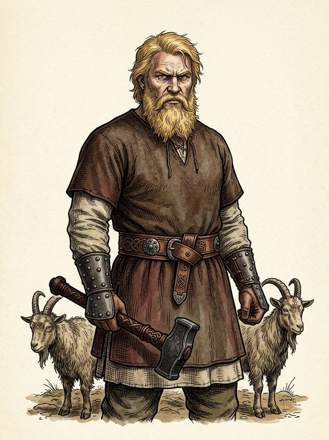
Age and build
Exceptionally strong and mighty
“He is the strongest of all gods and men, and rules over the realm which is called Thrudvang” (Younger Edda Anderson, part 3)
Fair of face when young
“So fair of face was he, when he stood by other men, as when ivory is set in oak; his hair was fairer than gold” (Younger Edda Anderson, part 2)
Full strength by age twelve
“When he was twelve winters old he had full strength; then he lifted from the ground ten bear skins all at once” (Younger Edda Anderson, part 2)
Face and hair
Hair fairer than gold
“his hair was fairer than gold” (Younger Edda Anderson, part 2)
Bristling beard and hair when angry
“He shook his beard, | his hair was bristling” (Poetic Edda Bellows, part 1)
Fierce eyes when wrathful
“When he saw his eyes he thought he must fall down at the sight of them alone” (Younger Edda Anderson, part 5)
Dress
Wears a belt of strength
“He girded himself with his Megingjarder, whereby his asa-might increased” (Younger Edda Anderson, part 5)
Uncouth appearance often mistaken for a tramp
“the god’s uncouth appearance often leading to such mistakes” (Poetic Edda Bellows, part 19)
Voice and speech
Speaks directly and forcefully
“Thor replied that he preferred to compete with someone in drinking” (Younger Edda Anderson, part 5)
Becomes wrathful and loud when challenged
“Then answered Hrungner, looking with anything but friendly eyes at Thor, and said that Odin had invited him to drink” (Younger Edda Anderson, part 6)
Signature words
Called Vingthor meaning the Hurler
“Vingthor (“Thor the Hurler”): cf. Thrymskvitha, 1” (Poetic Edda Bellows, part 19)
Called Asa-Thor meaning Thor of the Gods
“Asathor: Thor goes by various names in the poems: e.g., Vingthor, Vingnir, Hlorrithi. Asathor means “Thor of the Gods” (Poetic Edda Bellows, part 14)
Gait and mannerisms
Travels by goat-drawn chariot
“Lord of the goats: Thor, because of his goat-drawn chariot” (Poetic Edda Bellows, part 15)
Often travels on foot or journeys to the east
“Thor came not, as he was on a journey in the East” (Poetic Edda Bellows, part 15)
Grips his hammer tightly when wrathful
“Thor took hold of the handle of his hammer so hard that his knuckles grew white” (Younger Edda Anderson, part 5)
Strengths
Mightiest of all gods and men
“He is the strongest of all gods and men, and rules over the realm which is called Thrudvang” (Younger Edda Anderson, part 3)
Kills the Midgard-serpent at Ragnarok
“Asa-Thor fells the Midgard-serpent with his Mjolner, but he retreats only nine paces when he himself falls dead, suffocated by the serpent’s venom” (Younger Edda Anderson, part 1)
Flaws
Easily provoked to wrath
“Wild was Vingthor | when he awoke, And when his mighty | hammer he missed” (Poetic Edda Bellows, part 1)
Can be temporarily outwitted by giants using illusions
“Now I will tell you the truth, since you have come out of the burg, that if I live, and may have my way, you shall never enter it again; and this I know, forsooth, that you should never have come into it had I before known that you were so strong” (Younger Edda Anderson, part 5)
Vulnerable to the Midgard-serpent's venom
“Asa-Thor fells the Midgard-serpent with his Mjolner, but he retreats only nine paces when he himself falls dead, suffocated by the serpent’s venom” (Younger Edda Anderson, part 1)
Traits
Protector of gods and men against giants
“Thor has might enough, | but never a heart; For cowardly fear | in a glove wast thou fain to crawl” (Poetic Edda Bellows, part 13)
Friend to the peasant and common folk
“Concerning Thor as the friend of man, particularly of the peasant class” (Poetic Edda Bellows, part 15)
Honorable and refuses to act cowardly
“Then Thor the mighty | his answer made: “Me would the gods | unmanly call If I let bind | the bridal veil” (Poetic Edda Bellows, part 18)
Accepts challenges to duels
“Thor was by no means the man to refuse to fight a duel when he was challenged, an honor which never had been shown him before” (Younger Edda Anderson, part 6)
Lines in their own words
Identifying himself with pride
“I am Othin’s son, Meili’s brother, | and Magni’s father, The strong one of the gods; | with Thor now speech canst thou get” (Poetic Edda Bellows, part 13)
Boasting of his conquests
“In Valland I was, | and wars I raised, Princes I angered, | and peace brought never” (Poetic Edda Bellows, part 13)
Responding to insult about his strength
“Little as you call me, let anyone who likes come hither and wrestle with me, for now I am wroth” (Younger Edda Anderson, part 5)
Declaring his intent to continue a challenge
“Thor said he wished to row a while longer, and so he did; but Hymer was by no means in a happy mood” (Younger Edda Anderson, part 5)
Expressing gratitude to his son
“Then Thor arose, greeted his son lovingly, saying that he would become great and powerful” (Younger Edda Anderson, part 6)
Reference sheet
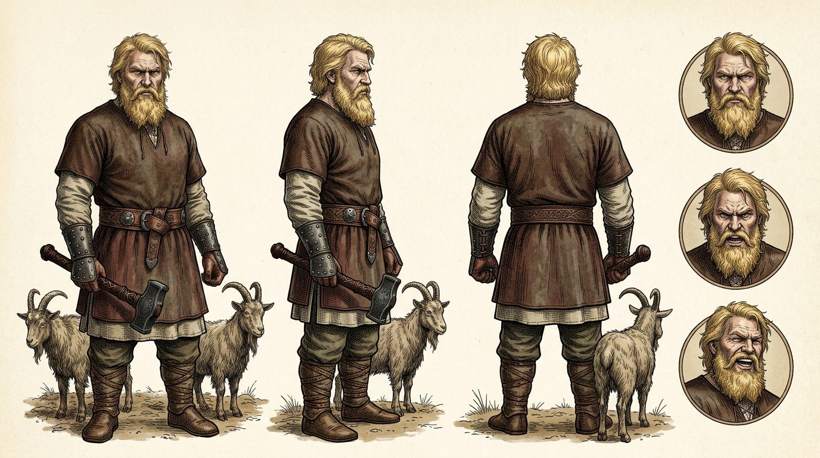
Film looks we will not copy
- Marvel Thor: blond hair, red cape, silver disc armour, winged helmet, long handled hammer
- Chris Hemsworth film look
- Any comic, film or game styling
- Winged or horned helmets from Wagner stagings
Always book accurate. Every quote above was checked word for word against our stored copy of the text. Pictures are made with AI from the book's own description and checked by hand for film looks.