The Scarecrow
Fairy tale. From The Wonderful Wizard of Oz, L. Frank Baum (1900). A straw-stuffed figure placed on a pole in a cornfield who comes to life and joins Dorothy's quest for brains.
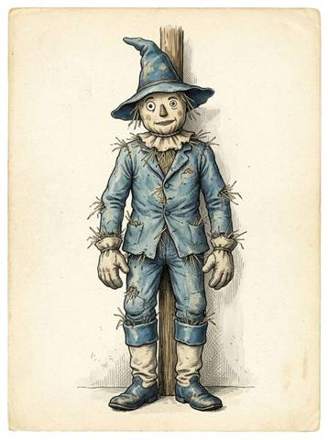
Age and build
Constructed figure of indeterminate age
“Its head was a small sack stuffed with straw, with eyes, nose, and mouth painted on it to represent a face” (The Wonderful Wizard Of Oz, chapter 3)
Body entirely stuffed with straw
“the rest of the figure was a blue suit of clothes, worn and faded, which had also been stuffed with straw” (The Wonderful Wizard Of Oz, chapter 3)
Face and hair
Painted face on sack head
“Its head was a small sack stuffed with straw, with eyes, nose, and mouth painted on it to represent a face” (The Wonderful Wizard Of Oz, chapter 3)
Queer painted face
“While Dorothy was looking earnestly into the queer, painted face of the Scarecrow, she was surprised to see one of the eyes slowly wink at her” (The Wonderful Wizard Of Oz, chapter 3)
Dress
Blue pointed hat from a Munchkin
“An old, pointed blue hat, that had belonged to some Munchkin, was perched on his head” (The Wonderful Wizard Of Oz, chapter 3)
Worn and faded blue suit
“the rest of the figure was a blue suit of clothes, worn and faded, which had also been stuffed with straw” (The Wonderful Wizard Of Oz, chapter 3)
Old boots with blue tops
“On the feet were some old boots with blue tops, such as every man wore in this country” (The Wonderful Wizard Of Oz, chapter 3)
Voice and speech
Rather husky voice
“Good day,” said the Scarecrow, in a rather husky voice” (The Wonderful Wizard Of Oz, chapter 3)
Speaks confidentially
“I’ll tell you a secret,” he continued, as he walked along” (The Wonderful Wizard Of Oz, chapter 3)
Cheerful manner of speech
“I don’t know enough,” replied the Scarecrow cheerfully” (The Wonderful Wizard Of Oz, chapter 5)
Signature words
Brains as obsessive concern
“I do not want people to call me a fool, and if my head stays stuffed with straw instead of with brains, as yours is, how am I ever to know anything” (The Wonderful Wizard Of Oz, chapter 3)
Fool as self-descriptor
“It is such an uncomfortable feeling to know one is a fool” (The Wonderful Wizard Of Oz, chapter 4)
Straw as defining characteristic
“My head is stuffed with straw, you know, and that is why I am going to Oz to ask him for some brains” (The Wonderful Wizard Of Oz, chapter 5)
Humbug as accusation
“you’re a humbug” (The Wonderful Wizard Of Oz, chapter 15)
Gait and mannerisms
Stumbles and falls due to lack of brains
“the Scarecrow often stumbled over the yellow bricks, which were here very uneven. Sometimes, indeed, they were broken or missing altogether, leaving holes that Toto jumped across and Dorothy walked around. As for the Scarecrow, having no brains, he walked straight ahead, and so stepped into the holes and fell at full length on the hard bricks” (The Wonderful Wizard Of Oz, chapter 4)
Clumsy with small objects
“His padded hands were so clumsy and the nuts were so small that he dropped almost as many as he put in the basket” (The Wonderful Wizard Of Oz, chapter 7)
Stands patiently without tiring
“The Scarecrow, who was never tired, stood up in another corner and waited patiently until morning came” (The Wonderful Wizard Of Oz, chapter 4)
Bows with straw stiffness
“When the Scarecrow had bowed, as prettily as his straw stuffing would let him, before this beautiful creature” (The Wonderful Wizard Of Oz, chapter 11)
Strengths
Cannot be physically hurt
“I don’t mind my legs and arms and body being stuffed, because I cannot get hurt. If anyone treads on my toes or sticks a pin into me, it doesn’t matter, for I can’t feel it” (The Wonderful Wizard Of Oz, chapter 3)
Never tires or needs rest
“I shall not mind it, for I can’t get tired” (The Wonderful Wizard Of Oz, chapter 3)
Can see in darkness
“the Scarecrow declared he could see as well as by day” (The Wonderful Wizard Of Oz, chapter 4)
Effective against crows
“And when the crows saw him they were frightened, as these birds always are by scarecrows, and did not dare to come any nearer” (The Wonderful Wizard Of Oz, chapter 12)
Becomes a capable ruler
“The Scarecrow was now the ruler of the Emerald City, and although he was not a Wizard the people were proud of him” (The Wonderful Wizard Of Oz, chapter 18)
Flaws
Lacks brains and intelligence
“I am only a Scarecrow, stuffed with straw. Therefore I have no brains” (The Wonderful Wizard Of Oz, chapter 11)
Walks straight into obstacles
“As for the Scarecrow, having no brains, he walked straight ahead, and so stepped into the holes and fell at full length on the hard bricks” (The Wonderful Wizard Of Oz, chapter 4)
Clumsy and awkward movements
“The Scarecrow climbed up the ladder first, but he was so awkward that Dorothy had to follow close behind and keep him from falling off” (The Wonderful Wizard Of Oz, chapter 20)
Traits
Selfless and protective of others
“I will,” declared the Scarecrow, “for, if you found that you could not jump over the gulf, Dorothy would be killed, or the Tin Woodman badly dented on the rocks below. But if I am on your back it will not matter so much, for the fall would not hurt me at all” (The Wonderful Wizard Of Oz, chapter 7)
Thoughtful and resourceful problem-solver
“Wait a minute!” called the Scarecrow. He had been thinking what was best to be done, and now he asked the Woodman to chop away the end of the tree that rested on their side of the ditch” (The Wonderful Wizard Of Oz, chapter 7)
Loyal and devoted friend
“I will go too,” declared the Scarecrow; “but I shall not be of much help to you, I am such a fool” (The Wonderful Wizard Of Oz, chapter 11)
Laughs at his own misfortunes
“It never hurt him, however, and Dorothy would pick him up and set him upon his feet again, while he joined her in laughing merrily at his own mishap” (The Wonderful Wizard Of Oz, chapter 4)
Grateful and appreciative
“Thank you very much,” said the Scarecrow, when he had been set down on the ground. “I feel like a new man” (The Wonderful Wizard Of Oz, chapter 3)
Lines in their own words
First greeting
“Good day,” said the Scarecrow, in a rather husky voice” (The Wonderful Wizard Of Oz, chapter 3)
Expressing his central concern
“I do not want people to call me a fool, and if my head stays stuffed with straw instead of with brains, as yours is, how am I ever to know anything” (The Wonderful Wizard Of Oz, chapter 3)
Expressing self-doubt
“I shall not be of much help to you, I am such a fool” (The Wonderful Wizard Of Oz, chapter 11)
Accusing the Wizard
“you’re a humbug” (The Wonderful Wizard Of Oz, chapter 15)
Celebrating his new brains
“I’ll find a way to use them, never fear” (The Wonderful Wizard Of Oz, chapter 15)
Reference sheet
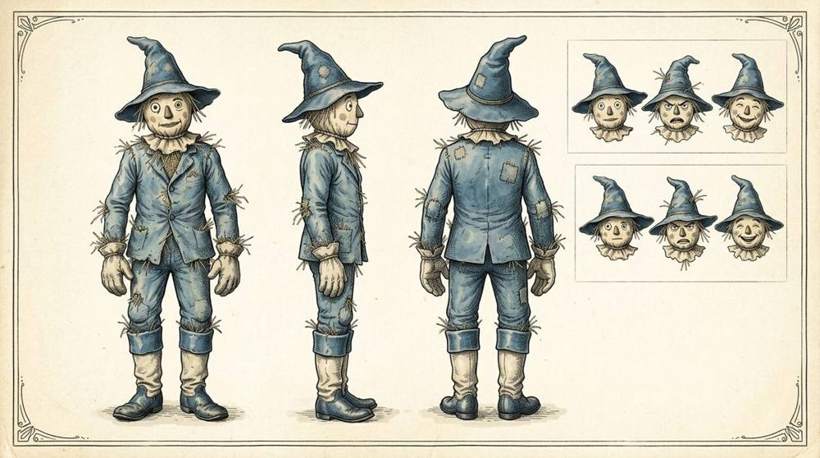
Film looks we will not copy
- Ray Bolger in the 1939 MGM film: sack face with stitched lines, brown hat, rope belt, brown straw clothes
- The song 'If I Only Had a Brain' and any film lyrics
- Ruby slippers, which are MGM's, and green skinned witch designs
- Wicked stage and film designs
Every quote above was checked word for word against our stored copy of the text. Pictures are made with AI from the book's own description and checked by hand for film looks.