Sherlock Holmes
Detective. From A Study in Scarlet (1887) and The Adventures of Sherlock Holmes (1892), Arthur Conan Doyle. A brilliant consulting detective of extraordinary analytical powers who solves crimes through keen observation and logical deduction.
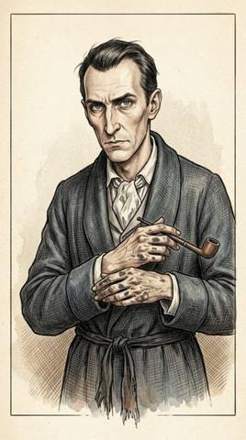
Age and build
tall and spare figure
“his tall, spare figure pass twice in a dark silhouette against the blind” (The Adventures Of Sherlock Holmes, chapter 1)
long, thin legs
“stretching his long, thin legs towards the fire” (The Adventures Of Sherlock Holmes, chapter 10)
tall and gaunt
“his tall, gaunt figure made even gaunter and taller by his long grey travelling-cloak” (The Adventures Of Sherlock Holmes, chapter 4)
Face and hair
strong-set aquiline features
“the light shining upon his strong-set aquiline features” (The Adventures Of Sherlock Holmes, chapter 6)
face flushed and darkened when on the scent
“His face flushed and darkened. His brows were drawn into two hard black lines, while his eyes shone out from beneath them with a steely glitter” (The Adventures Of Sherlock Holmes, chapter 4)
thin, eager face
“there was no answering smile in Holmes’ thin, eager face” (The Adventures Of Sherlock Holmes, chapter 11)
Dress
purple dressing-gown at home
“He was lounging upon the sofa in a purple dressing-gown, a pipe-rack within his reach upon the right” (The Adventures Of Sherlock Holmes, chapter 7)
long grey travelling-cloak and close-fitting cloth cap
“his tall, gaunt figure made even gaunter and taller by his long grey travelling-cloak and close-fitting cloth cap” (The Adventures Of Sherlock Holmes, chapter 4)
pea-jacket for outdoor work
“buttoning up his pea-jacket and taking his heavy hunting crop from the rack” (The Adventures Of Sherlock Holmes, chapter 2)
large blue dressing-gown for all-night work
“He took off his coat and waistcoat, put on a large blue dressing-gown” (The Adventures Of Sherlock Holmes, chapter 6)
Voice and speech
speaks with sarcasm and dry wit
“Sherlock Holmes sniffed sardonically. “Lecoq was a miserable bungler,” he said, in an angry voice” (A Study In Scarlet, chapter 2)
speaks dryly and with awareness
“I was aware of it,” said Holmes dryly” (The Adventures Of Sherlock Holmes, chapter 1)
speaks blandly and suavely
“You will excuse me,” said Holmes blandly, “but I could not help overhearing the questions” (The Adventures Of Sherlock Holmes, chapter 7)
Signature words
Elementary deductions
“without any help save a few very ordinary deductions I was able to lay my hand upon the criminal” (A Study In Scarlet, chapter 14)
The little things are infinitely the most important
“It has long been an axiom of mine that the little things are infinitely the most important” (The Adventures Of Sherlock Holmes, chapter 3)
Data, data, data
“Data! data! data!” he cried impatiently. “I can’t make bricks without clay” (The Adventures Of Sherlock Holmes, chapter 12)
My dear fellow or My dear Watson
“My dear fellow,” he cried, wringing Holmes’ unresponsive hand” (A Study In Scarlet, chapter 6)
Commonplace
“Commonplace,” said Holmes, though I thought from his expression that he was pleased” (A Study In Scarlet, chapter 3)
Peculiar
“Peculiar—that is the very word,” said Holmes” (The Adventures Of Sherlock Holmes, chapter 1)
Gait and mannerisms
paces the room swiftly and eagerly when working
“He was pacing the room swiftly, eagerly, with his head sunk upon his chest and his hands clasped behind him” (The Adventures Of Sherlock Holmes, chapter 1)
puts fingertips together in judicial moods
“relapsing into his armchair and putting his fingertips together, as was his custom when in judicial moods” (The Adventures Of Sherlock Holmes, chapter 2)
chuckles and wriggles in chair when in high spirits
“Holmes chuckled and wriggled in his chair, as was his habit when in high spirits” (The Adventures Of Sherlock Holmes, chapter 2)
closes eyes and settles into armchair when listening
“murmured Holmes, settling himself down in his armchair and closing his eyes” (The Adventures Of Sherlock Holmes, chapter 1)
Strengths
extraordinary powers of observation and deduction
“I had no keener pleasure than in following Holmes in his professional investigations, and in admiring the rapid deductions, as swift as intuitions, and yet always founded on a logical basis” (The Adventures Of Sherlock Holmes, chapter 8)
can identify criminals within three days
“without any help save a few very ordinary deductions I was able to lay my hand upon the criminal within three days” (A Study In Scarlet, chapter 14)
exceptionally strong in the fingers
“though I am exceptionally strong in the fingers, it would take me all my time to break it” (The Adventures Of Sherlock Holmes, chapter 11)
maintains comprehensive index of information
“For many years he had adopted a system of docketing all paragraphs concerning men and things, so that it was difficult to name a subject or a person on which he could not at once furnish information” (The Adventures Of Sherlock Holmes, chapter 1)
Flaws
dabbles with poisons and has scarred hands
“I dabble with poisons a good deal.” He held out his hand as he spoke, and I noticed that it was all mottled over with similar pieces of plaster, and discoloured with strong acids” (A Study In Scarlet, chapter 1)
can be blind to obvious facts
“I confess that I have been as blind as a mole, but it is better to learn wisdom late than never to learn it at all” (The Adventures Of Sherlock Holmes, chapter 6)
sometimes refuses to answer questions
“Again I had an opportunity of asking him a point blank question, and again my delicacy prevented me from forcing another man to confide in me” (A Study In Scarlet, chapter 2)
alternates between extreme languor and devouring energy
“The swing of his nature took him from extreme languor to devouring energy” (The Adventures Of Sherlock Holmes, chapter 2)
Traits
brilliant reasoner and acute observer
“The stage lost a fine actor, even as science lost an acute reasoner, when he became a specialist in crime” (The Adventures Of Sherlock Holmes, chapter 1)
passionate about solving problems
“He was at work again. He had risen out of his drug-created dreams and was hot upon the scent of some new problem” (The Adventures Of Sherlock Holmes, chapter 1)
capable of remarkable disguises and acting
“His expression, his manner, his very soul seemed to vary with every fresh part that he assumed” (The Adventures Of Sherlock Holmes, chapter 1)
devoted to justice and protecting the innocent
“If Horner were in danger it would be another thing; but this fellow will not appear against him, and the case must collapse. I suppose that I am commuting a felony, but it is just possible that I am saving a soul” (The Adventures Of Sherlock Holmes, chapter 7)
enthusiastic musician and composer
“My friend was an enthusiastic musician, being himself not only a very capable performer but a composer of no ordinary merit” (The Adventures Of Sherlock Holmes, chapter 2)
Lines in their own words
On a case
“It is quite a pretty little problem” (The Adventures Of Sherlock Holmes, chapter 1)
On his reasoning
“The proof of its intrinsic simplicity is, that without any help save a few very ordinary deductions I was able to lay my hand upon the criminal within three days” (A Study In Scarlet, chapter 14)
On observation
“Perhaps I have trained myself to see what others overlook. If not, why should you come to consult me” (The Adventures Of Sherlock Holmes, chapter 3)
Reference sheet
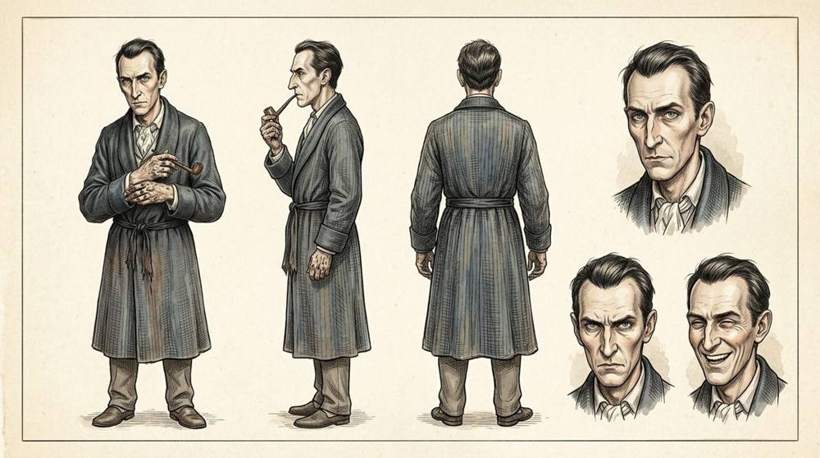
Film looks we will not copy
- BBC Sherlock modern look: long dark wool coat with turned up collar and blue scarf
- Robert Downey Jr film look: scruffy waistcoat, bare knuckle boxing
- Basil Rathbone film look and the line 'Elementary, my dear Watson', which is not in the books
- Curved calabash pipe, a stage prop added later
- Any modern day setting
Every quote above was checked word for word against our stored copy of the text. Pictures are made with AI from the book's own description and checked by hand for film looks.