Sancho Panza 🔒 Members
Translated classics. From Don Quixote, Miguel de Cervantes (1605), John Ormsby translation (1885). Sancho Panza is Don Quixote's loyal squire, a peasant of humble wit and practical sense who serves his master faithfully despite constant hardship and bewilderment.
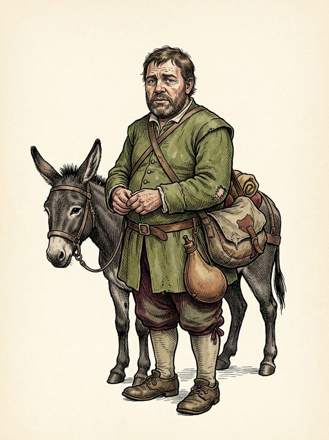
Age and build
squat and rotund figure
“The costume, the beard, and the fat squat figure of the new governor astonished all those who were not in on the secret” (Don Quixote, part 56)
described as overweight
“I never in all my life saw a lace-maker that died for love; when damsels are at work their minds are more set on finishing their tasks than on thinking of their loves. I speak from my own experience; for when I’m digging I never think of my old woman” (Don Quixote, part 68)
Face and hair
has a beard
“The costume, the beard, and the fat squat figure of the new governor astonished all those who were not in on the secret” (Don Quixote, part 56)
face becomes pale when distressed
“When Sancho discovered he could not find the book his face grew deadly pale” (Don Quixote, part 20)
Dress
wears a green hunting coat as governor
“Sancho alone, deserting Dapple at the sight of the mighty beast, took to his heels as hard as he could and strove in vain to mount a tall oak. As he was clinging to a branch, however, half-way up in his struggle to reach the top, the bough, such was his ill-luck and hard fate, gave way, and caught in his fall by a broken limb of the oak, he hung suspended in the air unable to reach the ground. Finding himself in this position, and that the green coat was beginning to tear” (Don Quixote, part 51)
wears a black buckram robe painted with flames during mock funeral
“an official crossed over, and approaching Sancho threw over him a robe of black buckram painted all over with flames of fire, and taking off his cap put upon his head a mitre such as those undergoing the sentence of the Holy Office wear” (Don Quixote, part 67)
Voice and speech
speaks in rustic, colloquial manner with proverbs
“Say no more, Sancho,” said Don Quixote at this; “don’t try to better it, and risk a fall; for in truth what thou hast said about death in thy rustic phrase is what a good preacher might have said” (Don Quixote, part 45)
uses folk wisdom and sayings
“it’s in a bad wind our corn is being winnowed;’ ‘misfortune comes upon us all at once like sticks on a dog” (Don Quixote, part 67)
speaks plainly without pretence
“He preaches well who lives well,” said Sancho, “and I know no more theology than that” (Don Quixote, part 45)
Signature words
uses 'señor' respectfully to address his master
“There is no occasion, señor, for wasting time or money on making that countenance” (Don Quixote, part 14)
invokes 'God' and 'heaven' in oaths and prayers
“There is no need of threats with me,” said Sancho, “for I am not a man to rob or murder anybody; let his own fate, or God who made him, kill each one” (Don Quixote, part 20)
frequently uses 'marry' as an exclamation
“By my faith, she is not dressed like a country girl, but like some fine court lady; egad, as well as I can make out” (Don Quixote, part 45)
swears by saints and religious references
“Holy Mary be good to me! Isn’t it Tom Cecial, my neighbour and gossip” (Don Quixote, part 41)
uses 'I swear' and 'I protest' for emphasis
“I swear in my heart she is a brave lass, and fit ‘to pass over the banks of Flanders” (Don Quixote, part 45)
Gait and mannerisms
clings to the duchess for security and comfort
“Sancho, who never found any pleasure or enjoyment in such doings, retreated to the wine-jars from which he had taken his delectable skimmings, considering that, as a holy place, that spot would be respected” (Don Quixote, part 45)
plucks his beard in extreme distress
“without more ado he seized his beard with both hands and plucked away half of it, and then, as quick as he could and without stopping, gave himself half a dozen cuffs on the face and nose till they were bathed in blood” (Don Quixote, part 20)
falls to his knees in prayer and devotion
“Sancho fell upon his knees devoutly appealing to heaven to deliver him from such imminent peril” (Don Quixote, part 48)
never separates from his donkey Dapple
“Cide Hamete observes that he seldom saw Sancho Panza without seeing Dapple, or Dapple without seeing Sancho Panza; such was their attachment and loyalty one to the other” (Don Quixote, part 51)
Strengths
possesses natural good sense and practical wisdom
“When I was expecting to hear of thy stupidities and blunders, friend Sancho, I have received intelligence of thy displays of good sense” (Don Quixote, part 60)
shows keen judgment in settling disputes as governor
“observing how the old man who swore gave the stick to his opponent while he was taking the oath, and swore that he had really and truly given him the crowns, and how as soon as he had done swearing he asked for the stick again, it came into his head that the sum demanded must be inside it” (Don Quixote, part 56)
has excellent memory and knowledge of wines
“What would you say, sir squire, to my having such a great natural instinct in judging wines that you have only to let me smell one and I can tell positively its country, its kind, its flavour and soundness” (Don Quixote, part 41)
Flaws
prone to cowardice and fear in dangerous situations
“Sancho alone, deserting Dapple at the sight of the mighty beast, took to his heels as hard as he could and strove in vain to mount a tall oak” (Don Quixote, part 51)
greedy for food and material gain
“Sancho had recourse to the larder of his alforjas and took out of them what he called the prog” (Don Quixote, part 63)
sometimes speaks out of turn and lacks discretion
“Tell me, thou new-fledged buffoon and old booby, dost thou think it right to offend and insult a duenna so deserving of reverence and respect as that one just now” (Don Quixote, part 49)
initially reluctant to accept hardship and punishment
“Thou wretched squire, soul of a pitcher, heart of a cork tree, with bowels of flint and pebbles; if, thou impudent thief, they bade thee throw thyself down from some lofty tower” (Don Quixote, part 51)
Traits
humble and respectful toward his betters
“I could manage the gram well enough,” said Sancho; “but for the mar I have neither leaning nor liking, for I don’t know what it is; but leaving this matter of the government in God’s hands” (Don Quixote, part 35)
grateful and appreciative of kindness
“Write to thy lord and lady and show thyself grateful to them, for ingratitude is the daughter of pride” (Don Quixote, part 60)
simple and honest in nature
“on the faith of a true squire, if he had said anything about me that was at all unbecoming an old Christian, such as I am, the deaf would have heard of it” (Don Quixote, part 35)
devoted to his wife Teresa
“I never in all my life saw a lace-maker that died for love; when damsels are at work their minds are more set on finishing their tasks than on thinking of their loves. I speak from my own experience; for when I’m digging I never think of my old woman; I mean my Teresa Panza, whom I love better than my own eyelids” (Don Quixote, part 68)
pragmatic and focused on material reality
“There is no need of threats with me,” said Sancho, “for I am not a man to rob or murder anybody; let his own fate, or God who made him, kill each one” (Don Quixote, part 20)
Lines in their own words
defending his master's honour
“Is it possible there is anyone in the world who will dare to say and swear that this master of mine is a madman” (Don Quixote, part 62)
expressing his simple honesty
“on the faith of a true squire, if he had said anything about me that was at all unbecoming an old Christian, such as I am, the deaf would have heard of it” (Don Quixote, part 35)
showing his devotion to his wife
“I mean my Teresa Panza, whom I love better than my own eyelids” (Don Quixote, part 68)
expressing wonder at his master's words
“Say, gentlemen shepherds, is there a village priest, be he ever so wise or learned, who could say what my master has said” (Don Quixote, part 62)
Reference sheet
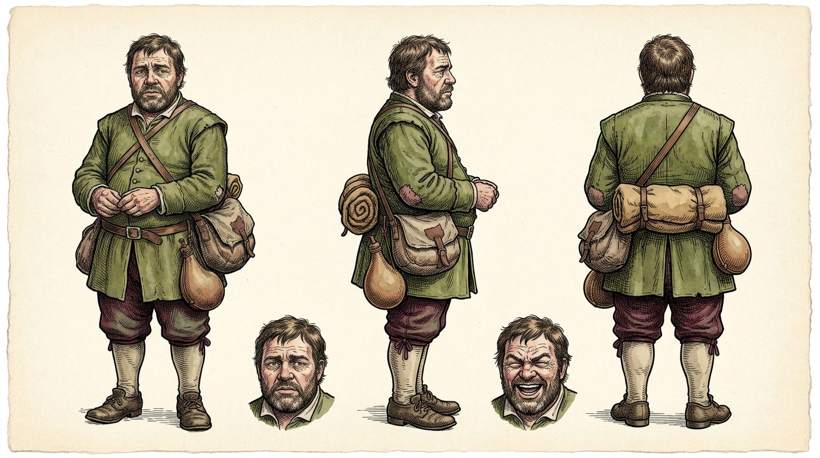
Film looks we will not copy
- Musical stage designs
- Any named film look
- Picasso's 1955 sketch, still in copyright
Always book accurate. Every quote above was checked word for word against our stored copy of the text. Pictures are made with AI from the book's own description and checked by hand for film looks.