Richard III 🔒 Members
Shakespeare. From Richard III, William Shakespeare (died 1616). Richard, Duke of Gloucester, is a deformed and ambitious nobleman who schemes his way to the throne through manipulation and murder, only to be destroyed by his own conscience and his enemies.
Care note: S: also a real historical person. We draw only the play's character, never as the real king.
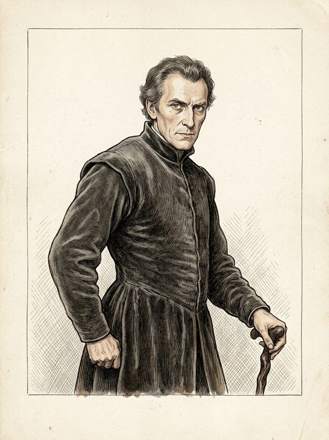
Age and build
Physically deformed and unfinished
“I, that am rudely stamped, and want love’s majesty To strut before a wanton ambling nymph; I, that am curtailed of this fair proportion, Cheated of feature by dissembling nature, Deformed, unfinished, sent before my time Into this breathing world scarce half made up” (Richard Iii, part 2)
Walks with a limp or halt
“That dogs bark at me as I halt by them” (Richard Iii, part 2)
Face and hair
The book is silent here, so we keep this plain and neutral.
Dress
Wears armour in battle, sometimes ill-favoured
“Enter Richard and Buckingham in rotten armour, marvellous ill-favoured” (Richard Iii, part 14)
Voice and speech
Speaks with authority and command
“Villains, set down the corse or, by Saint Paul, I’ll make a corse of him that disobeys” (Richard Iii, part 3)
Uses oaths and religious invocations frequently
“By holy Paul, they love his Grace but lightly That fill his ears with such dissentious rumours” (Richard Iii, part 4)
Capable of smooth, flattering speech when manipulating
“My tongue could never learn sweet smoothing word; But now thy beauty is proposed my fee, My proud heart sues, and prompts my tongue to speak” (Richard Iii, part 3)
Signature words
Uses 'marry' as an interjection
“Marry, as for Clarence, he is well repaid” (Richard Iii, part 4)
Addresses others as 'cousin'
“Cousin of Buckingham, a word with you” (Richard Iii, part 13)
Uses 'villain' as a term of contempt
“Thou art a traitor. Off with his head” (Richard Iii, part 13)
Invokes 'God' or 'heaven' in oaths
“Now, by the world” (Richard Iii, part 19)
Gait and mannerisms
Halts or limps when walking
“That dogs bark at me as I halt by them” (Richard Iii, part 2)
Speaks aside to himself, revealing inner thoughts
“So do I ever—(Speaks to himself) being well advised; For had I cursed now, I had cursed myself” (Richard Iii, part 4)
Gestures with his hand or dagger
“Vouchsafe to wear this ring” (Richard Iii, part 3)
Strengths
Master of manipulation and deception
“And thus I clothe my naked villany With odd old ends stol’n forth of Holy Writ, And seem a saint when most I play the devil” (Richard Iii, part 4)
Skilled in seduction and persuasion
“Fairer than tongue can name thee, let me have Some patient leisure to excuse myself” (Richard Iii, part 3)
Politically astute and strategic
“Plots have I laid, inductions dangerous, By drunken prophecies, libels, and dreams, To set my brother Clarence and the King In deadly hate the one against the other” (Richard Iii, part 2)
Courageous in battle
“A thousand hearts are great within my bosom. Advance our standards! Set upon our foes” (Richard Iii, part 23)
Flaws
Consumed by ambition and desire for power
“I am determined to prove a villain, And hate the idle pleasures of these days” (Richard Iii, part 2)
Tormented by guilt and conscience
“O coward conscience, how dost thou afflict me! The lights burn blue; it is now dead midnight. Cold fearful drops stand on my trembling flesh” (Richard Iii, part 23)
Capable of sudden, violent rage
“Off with his head! Now by Saint Paul I swear I will not dine until I see the same” (Richard Iii, part 13)
Paranoid and suspicious of others
“I will converse with iron-witted fools And unrespective boys; none are for me That look into me with considerate eyes” (Richard Iii, part 17)
Traits
Intelligent and quick-witted
“Thus, like the formal Vice, Iniquity, I moralize two meanings in one word” (Richard Iii, part 10)
Ruthless and willing to murder for power
“I wish the bastards dead, And I would have it suddenly performed” (Richard Iii, part 17)
Capable of feigning humility and piety
“I do beseech your Grace to pardon me, Who, earnest in the service of my God, Deferred the visitation of my friends” (Richard Iii, part 15)
Self-aware of his own villainy
“I am a villain. Yet I lie, I am not. Fool, of thyself speak well. Fool, do not flatter” (Richard Iii, part 23)
Lines in their own words
Opening soliloquy on his deformity and ambition
“But I, that am not shaped for sportive tricks, Nor made to court an amorous looking-glass; I, that am rudely stamped, and want love’s majesty” (Richard Iii, part 2)
Seducing Lady Anne with flattery
“Your beauty was the cause of that effect: Your beauty, that did haunt me in my sleep To undertake the death of all the world” (Richard Iii, part 3)
Defending himself against accusations
“Because I cannot flatter and look fair, Smile in men’s faces, smooth, deceive, and cog, Duck with French nods and apish courtesy, I must be held a rancorous enemy” (Richard Iii, part 4)
Confessing his villainy to himself
“I do the wrong, and first begin to brawl. The secret mischiefs that I set abroach I lay unto the grievous charge of others” (Richard Iii, part 4)
Expressing despair after his nightmare
“There is no creature loves me, And if I die no soul will pity me. And wherefore should they, since that I myself Find in myself no pity to myself” (Richard Iii, part 23)
Final defiant speech before battle
“Conscience is but a word that cowards use, Devised at first to keep the strong in awe. Our strong arms be our conscience, swords our law” (Richard Iii, part 23)
Reference sheet
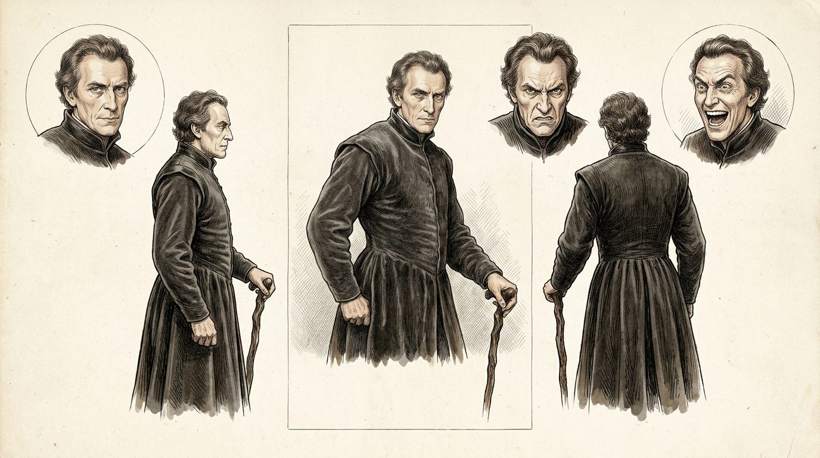
Film looks we will not copy
- Laurence Olivier 1955 film look
- Ian McKellen 1995 fascist uniform look
- The real king's portraits: we draw the play's character
Always book accurate. Every quote above was checked word for word against our stored copy of the text. Pictures are made with AI from the book's own description and checked by hand for film looks.