Quasimodo 🔒 Members
Translated classics. From Notre-Dame de Paris, Victor Hugo (1831), Isabel F. Hapgood translation (1888). Quasimodo is the deaf, hunchbacked bellringer of Notre-Dame, foundling and adopted son of Archdeacon Claude Frollo, who loves the cathedral and the gypsy Esmeralda with fierce devotion.
Care note: S: disfigured character. Draw with dignity, never mockery.
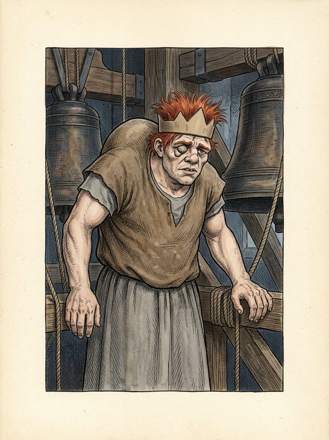
Age and build
Age around twenty years old
“In 1482, Quasimodo was about twenty years of age” (Notre Dame, part 17)
Robust and agile despite deformities
“For the hunchback was robust; for the bandy-legged fellow was agile; for the deaf man was malicious: three qualities which temper ridicule” (Notre Dame, part 9)
Enormous strength in his hands
“his huge hands gently detaching the cord which bruised her arms” (Notre Dame, part 42)
Face and hair
One eye only, with distinctive appearance
“Quasimodo, the one-eyed” (Notre Dame, part 7)
Red hair that rises when agitated
“his red hair rose erect, his breast heaving like a bellows, his eye flashed flames” (Notre Dame, part 17)
Deformed and hideous visage
“the sad and hideous visage of Quasimodo” (Notre Dame, part 9)
Gap-toothed appearance
“that gnome’s mask, one-eyed and gap-toothed” (Notre Dame, part 43)
Dress
Dressed in cardboard tiara and derisive robe as Pope of the Fools
“Quasimodo allowed them to array him in them without wincing, and with a sort of proud docility” (Notre Dame, part 7)
Voice and speech
Harsh and guttural voice
“replied, in a harsh and guttural voice, “Quasimodo” (Notre Dame, part 21)
Tongue torpid and awkward from disuse
“his tongue was torpid, awkward, and like a door whose hinges have grown rusty” (Notre Dame, part 17)
Rarely speaks, preferring silence
“he resolved upon a silence which he only broke when he was alone” (Notre Dame, part 17)
Voice of thunder rarely heard
“his voice of thunder, that voice which was so rarely heard, and which he never heard himself” (Notre Dame, part 41)
Signature words
Sanctuary, his cry of triumph
“Sanctuary! Sanctuary! Sanctuary” (Notre Dame, part 41)
Drink, his plea from the pillory
“Drink!” repeated Quasimodo panting” (Notre Dame, part 25)
Hum, his expression of satisfaction
“when it did good execution, he said, “Hum” (Notre Dame, part 49)
Gait and mannerisms
Climbs cathedral like a lizard
“like a lizard gliding along a perpendicular wall” (Notre Dame, part 17)
Squat, surly, monstrous bearing
“squat, surly, monstrous, bristling, gathering up his limbs, licking his boar’s tusks, growling like a wild beast” (Notre Dame, part 9)
Walks backwards as rearguard with threatening gestures
“walking backwards, squat, surly, monstrous, bristling, gathering up his limbs, licking his boar’s tusks, growling like a wild beast, and imparting to the crowd immense vibrations, with a look or a gesture” (Notre Dame, part 9)
Limps when walking
“he rose and retired limping, slowly, with drooping head” (Notre Dame, part 43)
Strengths
Extraordinary physical strength
“all that physical strength which had reached in Quasimodo such an extraordinary development” (Notre Dame, part 17)
Ability to defend the cathedral with projectiles
“Quasimodo was silently piling up plaster, stones, and rough blocks of stone, even the sacks of tools belonging to the masons, on the edge of the balustrade” (Notre Dame, part 49)
Keen sight compensating for deafness
“that eye which nature, by a sort of compensation, had made so piercing that it could almost supply the other organs which Quasimodo lacked” (Notre Dame, part 48)
Intimate knowledge of cathedral architecture
“no depths to which Quasimodo had not penetrated, no height which he had not scaled” (Notre Dame, part 17)
Flaws
Deaf from bells breaking his eardrums
“the bells had broken the drums of his ears; he had become deaf” (Notre Dame, part 17)
Hunchbacked and deformed
“Quasimodo, blind, hunchbacked, knock-kneed, was only an “almost” (Notre Dame, part 17)
One-eyed
“Quasimodo, the one-eyed” (Notre Dame, part 7)
Bandy-legged
“Quasimodo, the bandy-legged” (Notre Dame, part 7)
Mind atrophied by defective body
“It is certain that the mind becomes atrophied in a defective body. Quasimodo was barely conscious of a soul cast in his own image, moving blindly within him” (Notre Dame, part 17)
Traits
Profound gratitude to Claude Frollo
“Quasimodo’s gratitude was profound, passionate, boundless” (Notre Dame, part 17)
Loves the cathedral with instinctive devotion
“He was in sympathy with but two things in this world: Notre-Dame and Claude Frollo” (Notre Dame, part 17)
Capable of tenderness and pity
“His gnome’s eye, fastened upon her, inundated her with tenderness, sadness, and pity” (Notre Dame, part 41)
Submissive and docile to the archdeacon
“The archdeacon had in Quasimodo the most submissive slave, the most docile lackey, the most vigilant of dogs” (Notre Dame, part 17)
Capable of fierce protective rage
“Quasimodo placed himself in front of the priest, set in play the muscles of his athletic fists, and glared upon the assailants with the snarl of an angry tiger” (Notre Dame, part 9)
Experiences profound despair and grief
“Oh! all that I have ever loved” (Notre Dame, part 61)
Lines in their own words
His cry of triumph saving Esmeralda
“Sanctuary! Sanctuary! Sanctuary” (Notre Dame, part 41)
His gentle refusal to enter Esmeralda's cell
“No, no,” said he; “the owl enters not the nest of the lark” (Notre Dame, part 43)
His attempt to bring Phoebus to Esmeralda
“Follow me, captain; there is one here who desires to speak with you” (Notre Dame, part 44)
His final lament
“Oh! all that I have ever loved” (Notre Dame, part 61)
Reference sheet
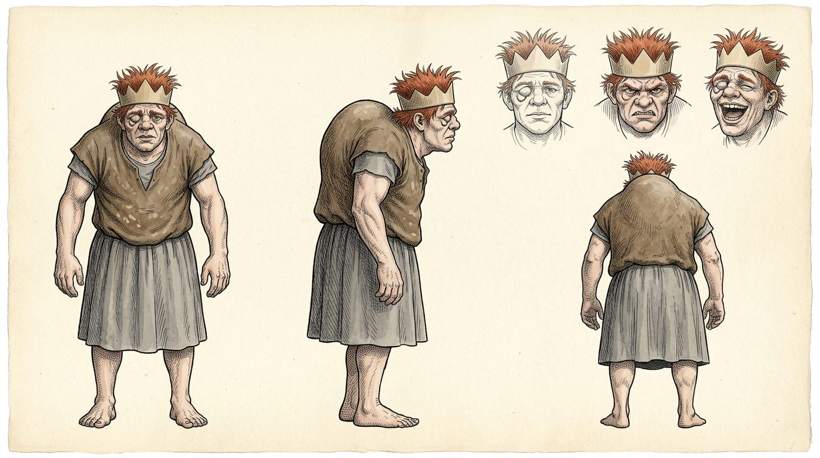
Film looks we will not copy
- Disney 1996 Hunchback design and songs
- Lon Chaney 1923 film look
- Charles Laughton 1939 film look
- Anthony Quinn 1956 film look
Always book accurate. Every quote above was checked word for word against our stored copy of the text. Pictures are made with AI from the book's own description and checked by hand for film looks.