Poseidon 🔒 Members
Gods and heroes. From The Iliad and The Odyssey, Homer, Samuel Butler translations (1898, 1900). Poseidon is the god of the sea and earthquakes, brother to Zeus, who aids the Achaeans in the Trojan War but later persecutes Odysseus for blinding his son Polyphemus.
Care note: Text: Samuel Butler died 1902. Butler uses the Roman name Neptune.
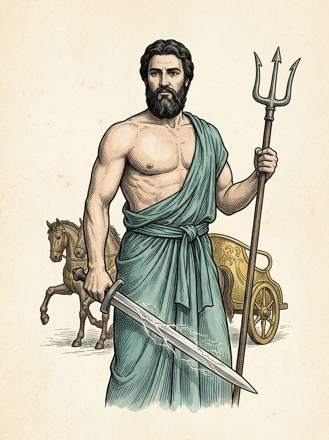
Age and build
Chest like Neptune's
“a waist like Mars, and a chest like that of Neptune” (Iliad Butler, part 2)
Face and hair
Dark-haired
“the dark-haired god led the way to the high earth-barrow of Hercules” (Iliad Butler, part 16)
Dress
Carries a trident
“Neptune himself, trident in hand, surveyed the work” (Iliad Butler, part 10)
Wields a terrible sword
“In his strong hand he grasped his terrible sword, keen of edge and flashing like lightning” (Iliad Butler, part 11)
Voice and speech
Speaks with authority and anger
“Neptune, lord of the earthquake, spoke, saying, “Father Jove, what mortal in the whole world will again take the gods into his counsel” (Iliad Butler, part 7)
Signature words
Referred to as 'lord of the earthquake'
“earth-encircling Neptune lord of the earthquake” (Iliad Butler, part 10)
Called 'earth-encircling'
“earth-encircling Neptune” (Iliad Butler, part 11)
Addressed as 'wide ruling lord'
“wide ruling lord of the earthquake” (Iliad Butler, part 7)
Called 'shaker of the earth'
“Neptune, shaker of the earth, then came near to him” (Iliad Butler, part 16)
Gait and mannerisms
Wags his head in anger
“he wagged his head and muttered to himself, saying, “Good heavens, so the gods have been changing their minds about Ulysses” (Odyssey Butler, part 5)
Strikes with his sceptre
“earth-encircling lord of the earthquake struck both of them with his sceptre and filled their hearts with daring” (Iliad Butler, part 10)
Strengths
Controls the sea and earthquakes
“from beneath Neptune shook the vast earth, and bade the high hills tremble” (Iliad Butler, part 16)
Grants safe passage at sea
“If great Neptune vouchsafes me a fair passage, in three days I shall be in Phthia” (Iliad Butler, part 8)
Protects favoured warriors
“Neptune stood guard over the son of Nestor, though the darts fell thickly round him” (Iliad Butler, part 11)
Flaws
Holds grudges relentlessly
“Neptune, who still nurses his bitter grudge against you for having blinded his son” (Odyssey Butler, part 8)
Fears Zeus and submits reluctantly
“Neptune feared to defend the Argives openly, but in the likeness of man, he kept on encouraging them” (Iliad Butler, part 10)
Resents being ordered by Zeus
“Neptune was very angry and said, “Great heavens! strong as Jove may be, he has said more than he can do if he has threatened violence against me” (Iliad Butler, part 12)
Persecutes Odysseus with relentless storms
“all the gods had pity on him save Poseidon, who raged continually against godlike Odysseus” (Odyssey Butler, part 1)
Traits
Proud of his divine status and power
“We were three brothers whom Rhea bore to Saturn—Jove, myself, and Hades who rules the world below. Heaven and earth were divided into three parts, and each of us was to have an equal share” (Iliad Butler, part 12)
Protective of his offspring
“Neptune was exceedingly angry that his grandson Amphimachus should have fallen” (Iliad Butler, part 10)
Compassionate toward the Achaeans
“he pitied the Achaeans who were being overcome by the Trojans; and he was furiously angry with Jove” (Iliad Butler, part 10)
Vindictive toward those who offend him
“Neptune did not forget the threats with which he had already threatened Ulysses” (Odyssey Butler, part 10)
Lines in their own words
Complains to Zeus about lack of respect
“Father Jove, what mortal in the whole world will again take the gods into his counsel? See you not how the Achaeans have built a wall about their ships and driven a trench all round it, without offering hecatombs to the gods” (Iliad Butler, part 7)
Defies Zeus's command
“For all his strength, let him keep to his own third share and be contented without threatening to lay hands upon me as though I were nobody” (Iliad Butler, part 12)
Encourages the Achaeans in battle
“Argives, shall we let Hector son of Priam have the triumph of taking our ships and covering himself with glory? This is what he says that he shall now do, seeing that Achilles is still in dudgeon at his ship” (Iliad Butler, part 11)
Warns Aeneas to avoid Achilles
“Give way before him whensoever you meet him, lest you go down to the house of Hades even though fate would have it otherwise” (Iliad Butler, part 16)
Expresses anger at Odysseus's escape
“There now, swim up and down as you best can till you fall in with well-to-do people. I do not think you will be able to say that I have let you off too lightly” (Odyssey Butler, part 5)
Reference sheet
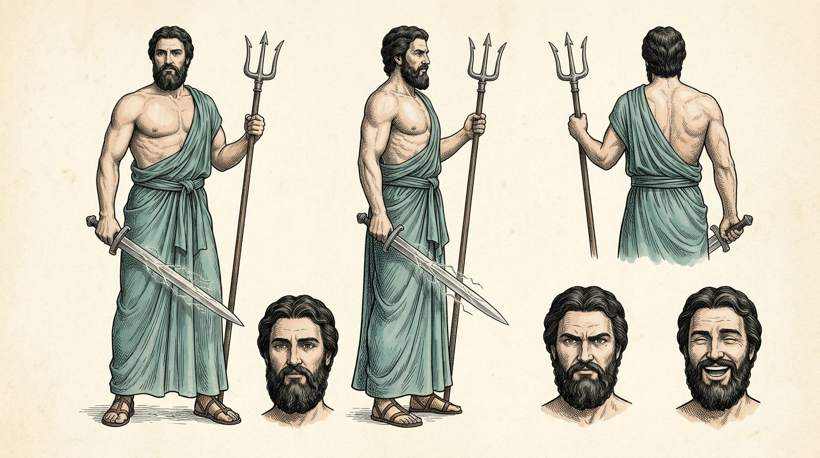
Film looks we will not copy
- Disney Little Mermaid King Triton
- Percy Jackson film or book designs
- Aquaman or any comic styling
- Video game designs
Always book accurate. Every quote above was checked word for word against our stored copy of the text. Pictures are made with AI from the book's own description and checked by hand for film looks.