Porthos 🔒 Members
Translated classics. From The Three Musketeers, Alexandre Dumas (1844), anonymous 19th century English translation. Porthos is a large, vain, and boisterous Musketeer known for his magnificent appearance, love of fine things, and loyal friendship despite his simple nature.
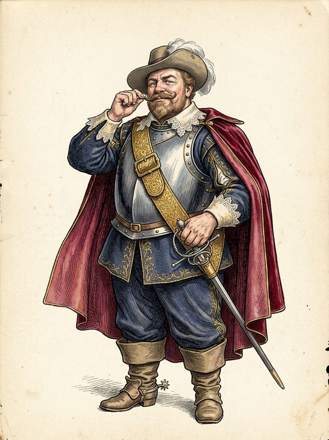
Age and build
Giant physical strength proverbial among Musketeers
“more than once in his struggles with Porthos he had overcome the giant whose physical strength was proverbial among the Musketeers” (The Three Musketeers, part 27)
Lofty stature indicating strength
“lofty stature, which indicated strength, the military dress, which indicated rank, and a ruddy countenance, which indicated familiarity with good living” (The Three Musketeers, part 32)
Face and hair
Handsome appearance with distinctive mustache
“Porthos was still the handsome Porthos” (The Three Musketeers, part 29)
Ruddy complexion
“a ruddy countenance, which indicated familiarity with good living” (The Three Musketeers, part 32)
Twists and elongates his mustache and imperial
“after having twisted his mustache and elongated his imperial, which always announced on his part the most triumphant resolutions” (The Three Musketeers, part 29)
Dress
Magnificent golden baldric much discussed and admired
“do you only wear such a fine golden baldric to suspend a sword of straw from it” (The Three Musketeers, part 3)
Long cloak worn with pride
“the wind blew out Porthos’s long cloak, and D’Artagnan rushed straight into the middle of it” (The Three Musketeers, part 4)
Splendid embroidered dress and magnificent uniform
“clothed in a magnificent dress covered with splendid embroidery” (The Three Musketeers, part 67)
Cuirass and spurs in new uniform
“his spurs jingled, his cuirass glittered, his sword knocked proudly against his ample limbs” (The Three Musketeers, part 40)
Voice and speech
Talks louder than others, taken for the chief
“Porthos was talking louder than the rest of us, he took him for the chief” (The Three Musketeers, part 20)
Self-sufficient and confident tone
“And what does he say?” asked Porthos, in a self-sufficient tone” (The Three Musketeers, part 2)
Speaks with admiration and enthusiasm
“The Gascon is full of ideas,” said Porthos, with admiration” (The Three Musketeers, part 9)
Signature words
Pardieu (by God)
“Pardieu! I spoke of them because Porthos talked of them himself” (The Three Musketeers, part 7)
Faith or My faith
“Faith! I don’t very well know. He hurt my shoulder. And you, Porthos” (The Three Musketeers, part 5)
The devil or Devil take me
“What the devil can they smell so extraordinary in this soup” (The Three Musketeers, part 32)
Ah or Ah, ah
“Ah, pardieu! Is that you?” said Porthos to D’Artagnan” (The Three Musketeers, part 25)
My dear or my dear friend
“What can you expect, my dear Porthos; a man is not privileged in all ways” (The Three Musketeers, part 25)
Gait and mannerisms
Walks with hands behind him, tossing his head
“Porthos continued to walk about with his hands behind him, tossing his head and repeating, “I shall follow up on my idea” (The Three Musketeers, part 29)
Raises his head and hand when passing his lodgings
“Every time he passed with a friend before his windows, at one of which Mousqueton was sure to be placed in full livery, Porthos raised his head and his hand, and said, “That is my abode” (The Three Musketeers, part 7)
Makes passes at walls and contortions like a dancer
“Porthos drew his sword from the scabbard, and made passes at the wall, springing back from time to time, and making contortions like a dancer” (The Three Musketeers, part 30)
Twists mustache in sign of despair or triumph
“Porthos from time to time pulled a hair or two from his mustache, in sign of despair” (The Three Musketeers, part 48)
Strengths
Proverbial physical strength among Musketeers
“more than once in his struggles with Porthos he had overcome the giant whose physical strength was proverbial among the Musketeers” (The Three Musketeers, part 27)
Skilled swordsman and fencer
“Porthos, abated, no doubt, of his too-great confidence by his adventure of Chantilly, played with skill and prudence” (The Three Musketeers, part 31)
Loyal and devoted friend
“we are never seen one without the others, and that we are called among the Musketeers and the Guards, at court and in the city, Athos, Porthos, and Aramis, or the Three Inseparables” (The Three Musketeers, part 5)
Man of execution and action
“He was a man of execution, this worthy Porthos” (The Three Musketeers, part 29)
Flaws
Vain and indiscreet about his affairs
“Vain and indiscreet, it was as easy to see through him as through a crystal” (The Three Musketeers, part 7)
Loose tongue about women and their carriages
“Porthos, one of whose faults was a great looseness of tongue. “A nice acquaintance, my friend” (The Three Musketeers, part 9)
Boastful and prone to exaggeration
“As Monsieur Porthos is a very boastful man, he insists that nobody shall know he has received this wound” (The Three Musketeers, part 25)
Easily humiliated and sensitive to slights
“All that which a man wounded in his self-love could let fall in the shape of imprecations and reproaches upon the head of a woman Porthos let fall” (The Three Musketeers, part 34)
Often in financial difficulties despite appearances
“At length when they found they were likely to be really in want, they got together, as a last effort, eight or ten pistoles, with which Porthos went to the gaming table. Unfortunately he was in a bad vein; he lost all” (The Three Musketeers, part 8)
Traits
Maintains magnificent appearance despite financial strain
“Thanks to the cares of Mousqueton, the exterior was far from announcing the distress of the interior” (The Three Musketeers, part 29)
Charming and good-natured despite vanity
“when he was informed of the cause of their hilarity, he shared it vociferously according to his custom” (The Three Musketeers, part 28)
Generous with friends and willing to share
“Athos, without saying anything, emptied his pockets, got together all his jewels, purses, aiguillettes, and gold chains, and offered them all to Porthos” (The Three Musketeers, part 7)
Ambitious and eager for advancement
“Porthos had his fits. On the days when he won he was insolent and ostentatious; if he lost, he disappeared completely for several days” (The Three Musketeers, part 7)
Lines in their own words
Boastful claim about his baldric
“No, upon honor and by the faith of a gentleman, I bought it with the contents of my own purse” (The Three Musketeers, part 2)
Enthusiastic agreement with friend's wit
“Oh, the Red Duke! Bravo! Bravo! The Red Duke!” cried Porthos, clapping his hands and nodding his head” (The Three Musketeers, part 2)
Expressing frustration about financial matters
“This is fine!” said Porthos to himself; “I am prettily caught” (The Three Musketeers, part 32)
Practical suggestion in crisis
“Well,” said Porthos, “arrange the table, Mousqueton, and while we breakfast, D’Artagnan will relate to us what has happened to him” (The Three Musketeers, part 25)
Expressing doubt about a plan
“But you are not one of us,” said Porthos” (The Three Musketeers, part 5)
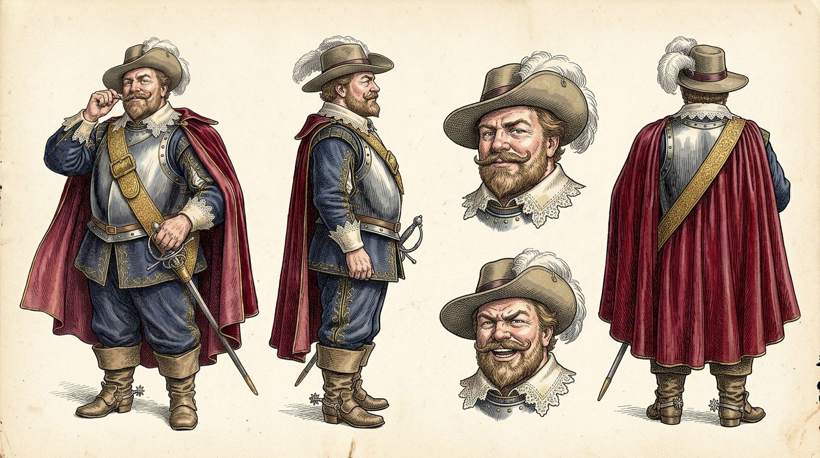
Reference sheet
Film looks we will not copy
- Disney 1993 film look
- BBC 2014 TV look
- Frank Finlay 1973 film look
- Disney Mickey Mouse musketeers
Always book accurate. Every quote above was checked word for word against our stored copy of the text. Pictures are made with AI from the book's own description and checked by hand for film looks.