Pip 🔒 Members
Dickens. From Great Expectations, Charles Dickens (1861). Pip is an orphan boy living with his sister and her blacksmith husband Joe in the Kent marshes who becomes a gentleman through mysterious great expectations.
Care note: C in early chapters: we use the adult Pip only.
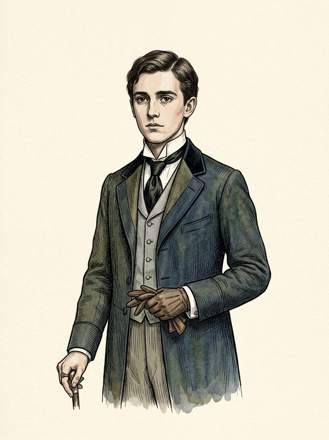
Age and build
Small child at story's beginning
“the small bundle of shivers growing afraid of it all and beginning to cry, was Pip” (Great Expectations, part 1)
Growing taller as a young man
“You are growing tall, Pip” (Great Expectations, part 12)
Face and hair
The book is silent here, so we keep this plain and neutral.
Dress
The book is silent here, so we keep this plain and neutral.
Voice and speech
Repeats his name with politeness
“Pip. Pip, sir” (Great Expectations, part 1)
Signature words
The book is silent here, so we keep this plain and neutral.
Gait and mannerisms
Prone to bolting food dangerously
“You’ll do yourself a mischief. It’ll stick somewhere. You can’t have chawed it, Pip” (Great Expectations, part 2)
Runs away in terror from convict encounter
“I felt that I could bear no more, and that I must run away. I released the leg of the table, and ran for my life” (Great Expectations, part 4)
Strengths
Capable of deep friendship and loyalty
“you and me is always friends, and I’d be the last to tell upon you, any time” (Great Expectations, part 2)
Shows gratitude and compassion to benefactor
“I was beginning to express my gratitude to my benefactor for the great liberality with which I was treated” (Great Expectations, part 36)
Flaws
Tells elaborate lies about his visit to Miss Havisham
“I have never been absolutely certain whether I uttered a shrill yell of terror, merely in spirit, or in the bodily hearing of the company” (Great Expectations, part 4)
Becomes ashamed of Joe when in genteel company
“I am afraid I was ashamed of the dear good fellow,—I know I was ashamed of him” (Great Expectations, part 13)
Obsessed with Estella despite her cruelty
“I asked myself the question whether I did not surely know that if Estella were beside me at that moment instead of Biddy, she would make me miserable” (Great Expectations, part 17)
Traits
Ambitious to rise above his common station
“I had always wanted to be a gentleman, and had often and often speculated on what I would do, if I were one” (Great Expectations, part 19)
Romantic and imaginative in nature
“its having been so strongly rooted in the breast of a boy whom nature and circumstances made so romantic” (Great Expectations, part 30)
Capable of deep introspection and remorse
“Pip, what a fool you are” (Great Expectations, part 17)
Grateful and humble when truly helped
“Ever the best of friends; an’t us, Pip? Don’t cry, old chap” (Great Expectations, part 7)
Lines in their own words
Identifying himself simply
“My father’s family name being Pirrip, and my Christian name Philip, my infant tongue could make of both names nothing longer or more explicit than Pip” (Great Expectations, part 1)
Expressing fear and confusion as a child
“I have never been absolutely certain whether I uttered a shrill yell of terror, merely in spirit, or in the bodily hearing of the company” (Great Expectations, part 4)
Confessing his shame to Joe
“I broke out crying and begging pardon, and hugged Joe round the neck” (Great Expectations, part 7)
Questioning his own foolishness over Estella
“I said to myself, “Pip, what a fool you are” (Great Expectations, part 17)
Expressing gratitude to his benefactor
“I was beginning to express my gratitude to my benefactor for the great liberality with which I was treated” (Great Expectations, part 36)
Acknowledging his debt and dependence
“I felt as if that familiar expression were applied to Miss Havisham” (Great Expectations, part 13)
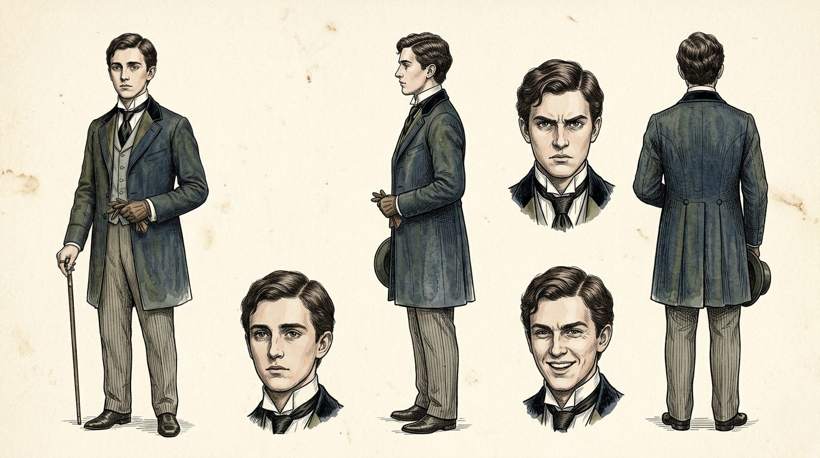
Reference sheet
Film looks we will not copy
- John Mills 1946 film look
- Ethan Hawke 1998 film look
Always book accurate. Every quote above was checked word for word against our stored copy of the text. Pictures are made with AI from the book's own description and checked by hand for film looks.