Erik, the Phantom of the Opera 🔒 Members
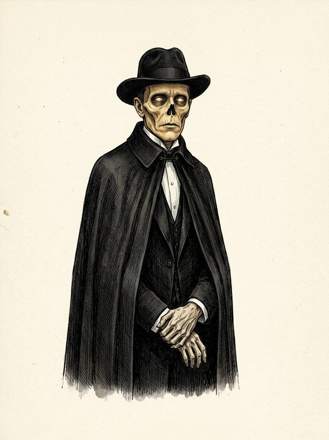
Gothic and horror. From The Phantom of the Opera, Gaston Leroux (1910), 1911 English translation credited to Alexander Teixeira de Mattos. Erik is a hideously ugly musical genius who lives secretly beneath the Opera, using his extraordinary talents for manipulation, ventriloquism, and engineering to control those around him.
Care note: T: the musical's half mask and logo are trade marks. We use Leroux's skull face only.
Age and build
About the same height as the Persian
“Erik was about the same height as myself” (The Phantom Of The Opera, part 24)
Face and hair
Yellow eyes that shine like candles in darkness
“I saw the two yellow eyes shining like candles” (The Phantom Of The Opera, part 21)
No nose, or possibly a transparent false nose
“the ghost had no nose and the person in question had. But M. Moncharmin declares, in his Memoirs, that the guest's nose was transparent: "long, thin and transparent" are his exact words” (The Phantom Of The Opera, part 3)
Hideous and repulsive ugliness beyond human pale
“His horrible, unparalleled and repulsive ugliness put him without the pale of humanity” (The Phantom Of The Opera, part 21)
Dress
Wears a black cloak and black mask
“A shadow in a long black cloak and a soft black felt hat passed along the pavement” (The Phantom Of The Opera, part 13)
Dressed in formal evening wear like an undertaker
“this ghost in dress-clothes who stalked about the building, from top to bottom, like a shadow” (The Phantom Of The Opera, part 1)
Wears a pasteboard nose with mustache when in public
“when he went out in the streets or ventured to show himself in public, he wore a pasteboard nose, with a mustache attached to it, instead of his own horrible hole of a nose” (The Phantom Of The Opera, part 21)
Voice and speech
Voice is soft and kind when first heard
“the voice was so soft and kind that I hardly felt frightened” (The Phantom Of The Opera, part 4)
Voice can be loud as thunder or soft as angels' voices at will
“Erik's voice—which was loud as thunder or soft as angels' voices, at will” (The Phantom Of The Opera, part 21)
Expert ventriloquist who throws his voice everywhere
“the ghost was an expert ventriloquist” (The Phantom Of The Opera, part 26)
Voice of thunder expressing revengeful soul
“his voice thundered forth his revengeful soul at every note” (The Phantom Of The Opera, part 12)
Signature words
Refers to himself as 'Erik' in third person
“I am Erik” (The Phantom Of The Opera, part 12)
Uses 'daroga' when addressing the Persian
“Listen, daroga ... listen to this” (The Phantom Of The Opera, part 26)
Addresses Christine as 'mademoiselle' or 'Christine Daae'
“Let us sing something from the Opera, Christine Daae” (The Phantom Of The Opera, part 12)
Uses 'Don Juan Triumphant' as his signature phrase
“I AM DON JUAN TRIUMPHANT” (The Phantom Of The Opera, part 12)
Speaks of himself as 'poor Erik'
“Poor Erik! Poor Erik” (The Phantom Of The Opera, part 12)
Uses 'Hop, grasshopper!' as a dismissive phrase
“The two minutes are past ... Good-by, mademoiselle... Hop, grasshopper” (The Phantom Of The Opera, part 25)
Gait and mannerisms
Makes no noise when walking, like a true ghost
“As became a real ghost, he made no noise in walking” (The Phantom Of The Opera, part 1)
Crawls and moves like a snake when emotional
“he crawled away like a snake” (The Phantom Of The Opera, part 12)
Vain and self-conceited, loves to astonish people
“Erik, who is a real monster—I have seen him at work in Persia, alas—is also, in certain respects, a regular child, vain and self-conceited, and there is nothing he loves so much, after astonishing people, as to prove all the really miraculous ingenuity of his mind” (The Phantom Of The Opera, part 21)
Laughs in a terrible, chuckling manner
“When Erik laughed, he was more terrible than ever. He jumped into the boat, chuckling so horribly that I could not help trembling” (The Phantom Of The Opera, part 21)
Strengths
Extraordinary musical talent and voice
“He already sang as nobody on this earth had ever sung before” (The Phantom Of The Opera, part 26)
Master of ventriloquism and legerdemain
“he practised ventriloquism and gave displays of legerdemain so extraordinary that the caravans returning to Asia talked about it during the whole length of their journey” (The Phantom Of The Opera, part 26)
Skilled in strangulation with the Punjab lasso
“He had lived in India and acquired an incredible skill in the art of strangulation” (The Phantom Of The Opera, part 21)
Flaws
Hideously ugly appearance that horrifies all who see him
“Oh, horror, horror, horror” (The Phantom Of The Opera, part 12)
Capable of murder and violence without moral restraint
“He was guilty of not a few horrors, for he seemed not to know the difference between good and evil” (The Phantom Of The Opera, part 26)
Obsessive and possessive love that drives him to madness
“he had decided TO KILL EVERYBODY AND HIMSELF WITH EVERYBODY if she did not consent to become his wife” (The Phantom Of The Opera, part 22)
Believes himself outside the pale of humanity with no duty toward others
“Thinking himself without the pale of humanity, he was restrained by no scruples” (The Phantom Of The Opera, part 26)
Traits
Lonely and desperate for human connection and love
“All I wanted was to be loved for myself” (The Phantom Of The Opera, part 22)
Capable of tenderness and vulnerability beneath his monstrosity
“My mother, daroga, my poor, unhappy mother would never ... let me kiss her” (The Phantom Of The Opera, part 26)
Ultimately capable of selfless love and sacrifice
“I slipped it into her little hand and said, 'There! ... Take it! ... Take it for you ... and him” (The Phantom Of The Opera, part 26)
Intelligent and manipulative, controlling through fear and mystery
“Erik knew most things about the public and private affairs of the Opera” (The Phantom Of The Opera, part 26)
Lines in their own words
Introducing himself to Christine
“It is true, Christine! ... I am not an Angel, nor a genius, nor a ghost ... I am Erik” (The Phantom Of The Opera, part 12)
Declaring his identity and power
“Look at me! I AM DON JUAN TRIUMPHANT” (The Phantom Of The Opera, part 12)
Expressing his desire for normal life
“I can't go on living like this, like a mole in a burrow! Don Juan Triumphant is finished; and now I want to live like everybody else” (The Phantom Of The Opera, part 22)
Confessing his love and vulnerability to the Persian
“Oh, how good it is, daroga, to kiss somebody on the forehead! ... You can't tell” (The Phantom Of The Opera, part 26)
Warning the Persian about his dangerous nature
“I won't answer for anything! ... If Erik's secrets cease to be Erik's secrets, IT WILL BE A BAD LOOKOUT FOR A GOODLY NUMBER OF THE HUMAN RACE” (The Phantom Of The Opera, part 21)
Releasing Christine and Raoul with his final gift
“There! ... Take it! ... Take it for you ... and him! ... It shall be my wedding-present a present from your poor, unhappy Erik” (The Phantom Of The Opera, part 26)
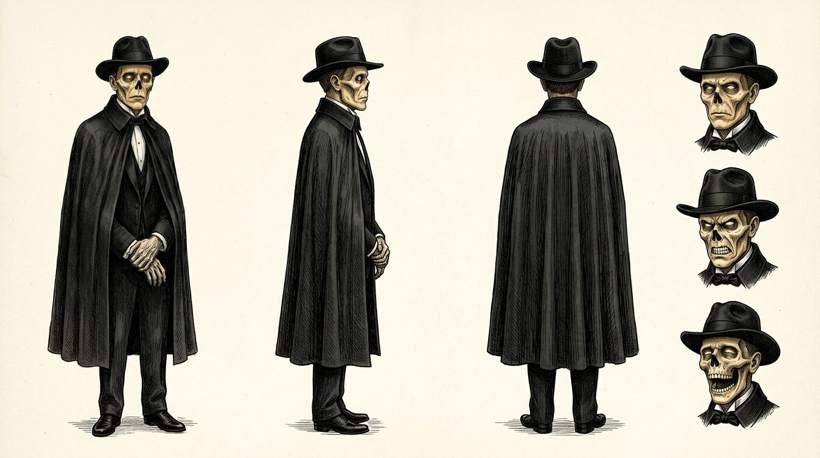
Reference sheet
Film looks we will not copy
- Andrew Lloyd Webber musical look: white half mask, red rose, chandelier poster
- Lon Chaney 1925 film make up
- Gerard Butler 2004 film look
- Any musical logo
Always book accurate. Every quote above was checked word for word against our stored copy of the text. Pictures are made with AI from the book's own description and checked by hand for film looks.