Odin 🔒 Members
Gods and heroes. From The Younger Edda, R.B. Anderson translation (1880), and The Poetic Edda, Henry Adams Bellows translation (1923). Odin is the highest and oldest of the gods, the All-Father who rules all things and grants victory in battle, wisdom, and poetry to those he favours.
Care note: T: Marvel holds trade marks in its Odin designs. We draw only from the Eddas.
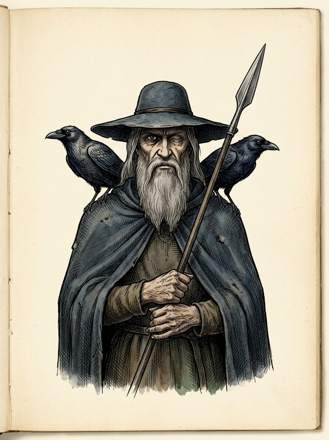
Age and build
appears as a young man in disguise
“He went out of Midgard in the guise of a young man” (Younger Edda Anderson, part 5)
Face and hair
wears a slouchy hat
“Sidhot = the slouchy hat” (Younger Edda Anderson, part 9)
has a long beard
“Sidskeg = the long-beard” (Younger Edda Anderson, part 9)
has burning eyes
“Baleyg = the burning-eye” (Younger Edda Anderson, part 9)
one eye is hidden or missing
“Othin, I know | where thine eye is hidden” (Poetic Edda Bellows, part 2)
Dress
wears a golden helmet
“with his golden helmet, resplendent byrnie, and his spear Gungner, he advances” (Younger Edda Anderson, part 5)
wears a dark-blue mantle in disguise
“He wore a dark-blue mantle and called himself Grimnir” (Poetic Edda Bellows, part 9)
Voice and speech
The book is silent here, so we keep this plain and neutral.
Signature words
called Alfather, father of all gods and men
“Odin is called Alfather, that he is the father of all gods and men” (Younger Edda Anderson, part 3)
called the High One
“Har = the High One” (Younger Edda Anderson, part 9)
called Ygg, the Terrible
“Ygg: Othin (“The Terrible” (Poetic Edda Bellows, part 11)
called Grimnir when in disguise
“called himself Grimnir, but said no more about himself” (Poetic Edda Bellows, part 9)
called the Wanderer
“Gangleri: “The Wanderer” (Poetic Edda Bellows, part 11)
called Hnikar in disguise
“Hnikar and Fjolnir: Othin gives himself both these names” (Poetic Edda Bellows, part 35)
Gait and mannerisms
rides his eight-legged horse Sleipnir through air and over sea
“Odin rode on his horse Sleipner to Jotunheim” (Younger Edda Anderson, part 6)
sits in his high-seat Hlidskjalf to see over all the world
“when Odin seated himself there in the high-seat, he saw over the whole world” (Younger Edda Anderson, part 3)
appears in many disguises and takes many forms
“Permeating all nature, he appears in all its forms” (Younger Edda Anderson, part 9)
Strengths
rules all things and all gods serve him as children serve a father
“He rules all things, but the other gods, each according to his might, serve him as children a father” (Younger Edda Anderson, part 3)
knows the fate of all things
“Frigg is his wife, and she knows the fate of men, although she tells not thereof” (Younger Edda Anderson, part 3)
obtained the mead of poetry and gave it to the gods and poets
“Suttung’s mead Odin gave to the asas and to those men who are able to make verses” (Younger Edda Anderson, part 6)
fights the Fenris-wolf at Ragnarok with his spear Gungner
“Odin rides first; with his golden helmet, resplendent byrnie, and his spear Gungner, he advances against the Fenris-wolf” (Younger Edda Anderson, part 5)
Flaws
sacrificed one of his eyes for wisdom at Mimer's well
“Alfather once came there and asked for a drink from the well, but he did not get it before he left one of his eyes as a pledge” (Younger Edda Anderson, part 3)
is swallowed and killed by the Fenris-wolf at Ragnarok
“The wolf swallows Odin, and thus causes his death” (Younger Edda Anderson, part 5)
Traits
wise and accomplished in all things
“he was a famous man for wisdom and all accomplishments” (Younger Edda Anderson, part 2)
god of war and victory
“Such names as these have reference to Odin’s divinity as creator, arranger and ruler of gods and men” (Younger Edda Anderson, part 9)
grants victory to chosen warriors
“Othin had promised him the victory” (Poetic Edda Bellows, part 37)
a wanderer who journeys through the worlds
“Ganglere, Gangrad and Vegtam = the wanderer, the waywont” (Younger Edda Anderson, part 9)
inventor and discoverer of runes
“Such names as Sanngetal = the true investigator; Farmatyr = the cargo-god, etc., refer to his various occupations as inventor, discoverer of runes” (Younger Edda Anderson, part 9)
Lines in their own words
speaks with authority about the creation of the world
“Thus is it said in the Vala’s Prophecy” (Younger Edda Anderson, part 2)
gives counsel and wisdom to warriors
“Hnikar and Fjolnir: Othin gives himself both these names in Grimnismol” (Poetic Edda Bellows, part 35)
speaks of his knowledge and power
“With Othin in knowledge | now have I striven, And ever the wiser thou art” (Poetic Edda Bellows, part 9)
Reference sheet
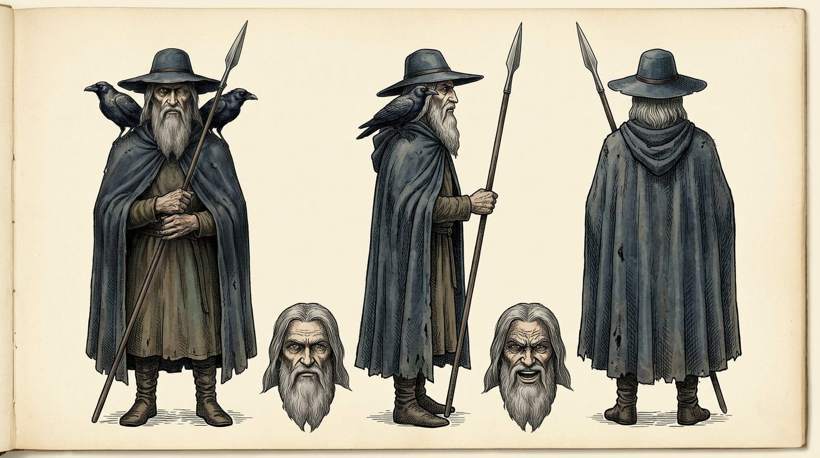
Film looks we will not copy
- Marvel Odin: gold armour and gold eye patch
- Anthony Hopkins film look
- American Gods TV look
- Any comic, film or game styling
- Gandalf or Tolkien styling
Always book accurate. Every quote above was checked word for word against our stored copy of the text. Pictures are made with AI from the book's own description and checked by hand for film looks.