Mr Rochester 🔒 Members
Romance and manners. From Jane Eyre, Charlotte Brontë (1847). A wealthy English gentleman of about forty, master of Thornfield Hall, who falls in love with his young governess Jane Eyre despite being secretly married to a mad woman.
Care note: S: locked his wife in the attic. No romance with any child.
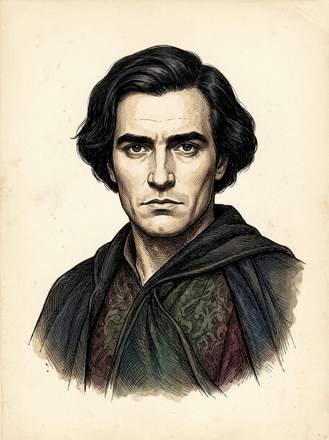
Age and build
Age approximately forty at time of governess employment
“Mr. Rochester was about forty, and this governess not twenty” (Jane Eyre, part 36)
Athletic build, broad-chested and thin-flanked
“I suppose it was a good figure in the athletic sense of the term—broad chested and thin flanked, though neither tall nor graceful” (Jane Eyre, part 13)
Face and hair
Broad, square forehead with horizontal sweep of black hair
“his square forehead, made squarer by the horizontal sweep of his black hair” (Jane Eyre, part 13)
Broad and jetty eyebrows
“I knew my traveller with his broad and jetty eyebrows” (Jane Eyre, part 13)
Decisive nose remarkable for character rather than beauty
“his decisive nose, more remarkable for character than beauty” (Jane Eyre, part 13)
Full nostrils denoting choler, grim mouth, chin and jaw
“his full nostrils, denoting, I thought, choler; his grim mouth, chin, and jaw—yes, all three were very grim, and no mistake” (Jane Eyre, part 13)
Great, dark eyes with occasional softness in their depths
“he had great, dark eyes, and very fine eyes, too—not without a certain change in their depths sometimes, which, if it was not softness, reminded you, at least, of that feeling” (Jane Eyre, part 14)
Granite-hewn features
“receiving the light of the fire on his granite-hewn features, and in his great, dark eyes” (Jane Eyre, part 14)
Dress
Wears a cloak when first encountered
“His shape, now divested of cloak, I perceived harmonised in squareness with his physiognomy” (Jane Eyre, part 13)
Sits in damask-covered chair in after-dinner mood
“Mr. Rochester, as he sat in his damask-covered chair, looked different to what I had seen him look before” (Jane Eyre, part 14)
Voice and speech
Deep and rather sarcastic voice
“the deep and rather sarcastic voice of Mr. Rochester, proceeding from the depths of an immense easy-chair at the fireside” (Jane Eyre, part 14)
Mellow, powerful bass that finds way through ear to heart
“he did—a mellow, powerful bass, into which he threw his own feeling, his own force; finding a way through the ear to the heart, and there waking sensation strangely” (Jane Eyre, part 17)
Speaks French fluently
“you speak my language as well as Mr. Rochester does” (Jane Eyre, part 11)
Signature words
Uses 'Humph' as an interjection
“Humph!” said Mr. Rochester, and he took his tea in silence” (Jane Eyre, part 13)
Addresses Jane as 'Janet'
“Soon to be Jane Rochester,” he added: “in four weeks, Janet; not a day more” (Jane Eyre, part 24)
Uses French phrases such as 'tiens-toi tranquille, enfant; comprends-tu'
“tiens-toi tranquille, enfant; comprends-tu” (Jane Eyre, part 14)
Calls Jane 'provoking puppet' and 'malicious elf'
“he had no such honeyed terms as “love” and “darling” on his lips: the best words at my service were “provoking puppet,” “malicious elf,” “sprite,” “changeling,” &c” (Jane Eyre, part 24)
Uses term 'fairy' for Jane
“How well you read me, you witch!” interposed Mr. Rochester” (Jane Eyre, part 25)
Gait and mannerisms
Half reclines on a couch, foot supported by cushion
“Half reclined on a couch appeared Mr. Rochester, his foot supported by the cushion” (Jane Eyre, part 13)
Makes strange and equivocal grimaces
“He made a curious grimace—one of his strange and equivocal demonstrations” (Jane Eyre, part 21)
Smiles rarely, with a smile that is real sunshine of feeling
“he smiled at me with a certain smile he had of his own, and which he used but on rare occasions. He seemed to think it too good for common purposes: it was the real sunshine of feeling” (Jane Eyre, part 22)
Walks with firm, resolute stride on wedding day
“I was hurried along by a stride I could hardly follow; and to look at Mr. Rochester’s face was to feel that not a second of delay would be tolerated for any purpose” (Jane Eyre, part 26)
Strengths
Possesses force to influence and spell to attract
“I have certain tastes and feelings in common with him. I must, then, repeat continually that we are for ever sundered” (Jane Eyre, part 17)
Talented and lively in society, general favourite
“Mr. Rochester is so talented and so lively in society, that I believe he is a general favourite” (Jane Eyre, part 16)
Courageous and selfless in fire, rescues servants and wife
“he went up to the attics when all was burning above and below, and got the servants out of their beds and helped them down himself, and went back to get his mad wife out of her cell” (Jane Eyre, part 36)
Physically strong and athletic
“he could have struck Mason, dashed him on the church-floor, shocked by ruthless blow the breath from his body” (Jane Eyre, part 26)
Flaws
Proud, sardonic, and harsh to those of inferior station
“He was proud, sardonic, harsh to inferiority of every description” (Jane Eyre, part 15)
Moody and unaccountably melancholic
“He was moody, too; unaccountably so; I more than once, when sent for to read to him, found him sitting in his library alone, with his head bent on his folded arms” (Jane Eyre, part 15)
Former faults of morality, though now corrected
“his former faults of morality (I say former, for now he seemed corrected of them) had their source in some cruel cross of fate” (Jane Eyre, part 15)
Sudden and headstrong nature capable of rash decisions
“a freak very possible to a nature so sudden and headstrong as his” (Jane Eyre, part 16)
Attempts bigamy and deceives Jane about his marriage
“Bigamy is an ugly word!—I meant, however, to be a bigamist; but fate has out-manoeuvred me, or Providence has checked me” (Jane Eyre, part 26)
Traits
Naturally a man of better tendencies and higher principles
“I believed he was naturally a man of better tendencies, higher principles, and purer tastes than such as circumstances had developed” (Jane Eyre, part 15)
Kind and generous to Adèle, his ward
“he was always kind to me and gave me pretty dresses and toys” (Jane Eyre, part 11)
Becomes more uniform and cordial in manner over time
“His deportment had now for some weeks been more uniform towards me than at the first. I never seemed in his way; he did not take fits of chilling hauteur” (Jane Eyre, part 15)
Capable of genuine affection and deep love
“He loved me so truly, that he knew no reluctance in profiting by my attendance: he felt I loved him so fondly, that to yield that attendance was to indulge my sweetest wishes” (Jane Eyre, part 38)
Lines in their own words
Sarcastic command to Adèle
“Yes, there is your ‘boite’ at last: take it into a corner, you genuine daughter of Paris, and amuse yourself with disembowelling it” (Jane Eyre, part 14)
Teasing Jane about her appearance
“You must see the carriage, Jane, and tell me if you don’t think it will suit Mrs. Rochester exactly; and whether she won’t look like Queen Boadicea, leaning back against those purple cushions” (Jane Eyre, part 22)
Proposing marriage to Jane
“Just this promise—‘I will be yours, Mr. Rochester” (Jane Eyre, part 27)
Confessing his marriage to Bertha
“I now inform you that she is my wife, whom I married fifteen years ago,—Bertha Mason by name” (Jane Eyre, part 26)
Expressing devotion after regaining Jane
“if she does, she will be too late, for our honeymoon will shine our life long: its beams will only fade over your grave or mine” (Jane Eyre, part 38)
Reference sheet
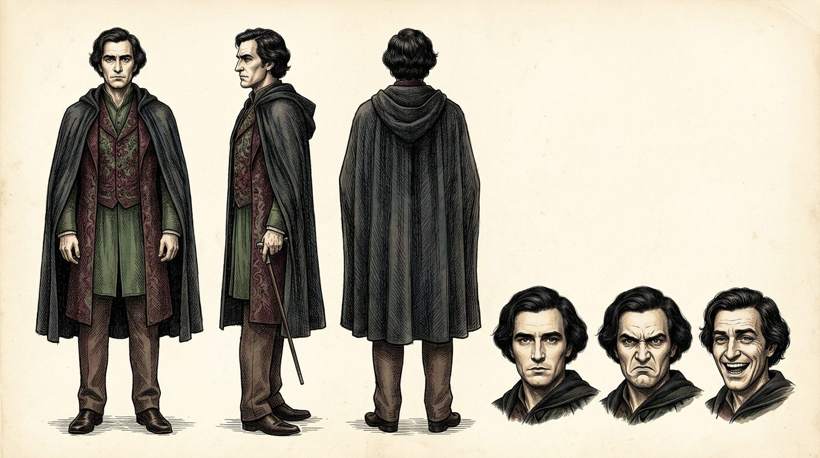
Film looks we will not copy
- Orson Welles, Toby Stephens or Michael Fassbender looks
Always book accurate. Every quote above was checked word for word against our stored copy of the text. Pictures are made with AI from the book's own description and checked by hand for film looks.