The Count of Monte Cristo 🔒 Members
Translated classics. From The Count of Monte Cristo, Alexandre Dumas (1844), anonymous 1846 English translation. Edmond Dantès, a young sailor unjustly imprisoned for fourteen years, escapes and becomes the mysterious Count of Monte Cristo, wielding immense wealth to execute elaborate vengeance against those who betrayed him.
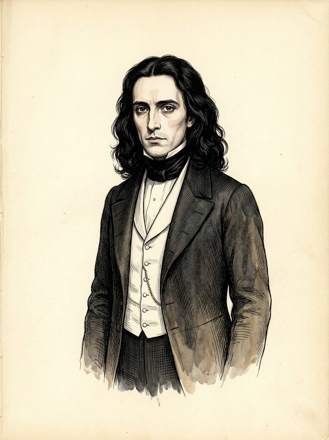
Age and build
Age upon escape from prison
“It was fourteen years, day for day, since Dantès’ arrest. He was nineteen when he entered the Château d’If; he was thirty-three when he escaped” (The Count Of Monte Cristo, part 21)
Natural stature and physical development
“he had also acquired, being naturally of a goodly stature, that vigor which a frame possesses which has so long concentrated all its force within itself” (The Count Of Monte Cristo, part 22)
Face and hair
Appearance after imprisonment: facial structure and expression
“The oval face was lengthened, his smiling mouth had assumed the firm and marked lines which betoken resolution; his eyebrows were arched beneath a brow furrowed with thought; his eyes were full of melancholy, and from their depths occasionally sparkled gloomy fires of misanthropy and hatred” (The Count Of Monte Cristo, part 22)
Hair and complexion
“his complexion, so long kept from the sun, had now that pale color which produces, when the features are encircled with black hair, the aristocratic beauty of the man of the north” (The Count Of Monte Cristo, part 22)
Hair length and appearance upon escape
“The barber gazed in amazement at this man with the long, thick and black hair and beard, which gave his head the appearance of one of Titian’s portraits” (The Count Of Monte Cristo, part 22)
Distinctive facial features as Count
“it was his pale complexion, his waving black hair, his calm and serene expression, his dark and melancholy eye, his mouth, chiselled with such marvellous delicacy, which so easily expressed such high disdain” (The Count Of Monte Cristo, part 70)
Dress
Habitual simplicity of dress in Paris
“The count appeared, dressed with the greatest simplicity, but the most fastidious dandy could have found nothing to cavil at in his toilet. Every article of dress—hat, coat, gloves, and boots—was from the first makers” (The Count Of Monte Cristo, part 40)
Voice and speech
Voice quality and tone
“the tones of his voice had made too powerful an impression on him the first time he had heard them for him ever again to forget them, hear them when or where he might. It was more especially when this man was speaking in a manner half jesting, half bitter, that Franz’s ear recalled most vividly the deep sonorous, yet well-pitched voice” (The Count Of Monte Cristo, part 34)
Signature words
Peculiar smile
“the count, smiling with his own peculiar smile” (The Count Of Monte Cristo, part 37)
Expression of irony and disdain
“his mouth, chiselled with such marvellous delicacy, which so easily expressed such high disdain” (The Count Of Monte Cristo, part 70)
Habitual courtesy and formality
“Good-evening, M. Beauchamp,” said Monte Cristo, as if this was the first time he had seen the journalist that evening; “be seated” (The Count Of Monte Cristo, part 88)
Measured, deliberate speech
“I told you I did not wish to be behind my time; I dressed myself in the carriage, and descended at the viscount’s door” (The Count Of Monte Cristo, part 40)
Philosophical and probing questions
“Listen,” said the count. “Do you understand the meaning of my words? You cannot take me for a commonplace man, a mere rattle, emitting a vague and senseless noise” (The Count Of Monte Cristo, part 117)
Gait and mannerisms
Composed, controlled demeanor
“As for the Count of Monte Cristo, he had never for an instant shown any appearance of having been moved” (The Count Of Monte Cristo, part 36)
Graceful, deliberate movement
“The count advanced, smiling, into the centre of the room, and approached Albert, who hastened towards him holding out his hand in a ceremonial manner” (The Count Of Monte Cristo, part 40)
Habit of observing others intently
“Monte Cristo, although apparently indifferent, had not lost one word of this conversation, and his penetrating eye had even read a hidden secret in the embarrassed manner of the secretary” (The Count Of Monte Cristo, part 54)
Sudden transformation when moved to anger
“The Count of Monte Cristo turned dreadfully pale; his eye seemed to burn with a devouring fire. He leaped towards a dressing-room near his bedroom, and in less than a moment, tearing off his cravat, his coat and waistcoat, he put on a sailor’s jacket and hat, from beneath which rolled his long black hair” (The Count Of Monte Cristo, part 92)
Strengths
Vast wealth and resources
“a fortune so brilliant, so unbounded, so unheard-of, that I must have been blind not to be conscious that God had endowed me with it to work out his own great designs” (The Count Of Monte Cristo, part 112)
Penetrating insight into human nature
“this singular man, who appears to fathom the motives of everyone” (The Count Of Monte Cristo, part 57)
Mastery of disguise and deception
“Lord Wilmore, having heard the door close after him, returned to his bedroom, where with one hand he pulled off his light hair, his red whiskers, his false jaw, and his wound, to resume the black hair, dark complexion, and pearly teeth of the Count of Monte Cristo” (The Count Of Monte Cristo, part 69)
Unwavering resolve and determination
“I became revengeful, cunning, and wicked, or rather, immovable as fate” (The Count Of Monte Cristo, part 112)
Knowledge of poisons and chemistry
“he drew from his pocket a marvellous casket, formed out of a single emerald and closed by a golden lid which unscrewed and gave passage to a small greenish colored pellet about the size of a pea” (The Count Of Monte Cristo, part 40)
Flaws
Obsessive pursuit of vengeance
“He renewed against Danglars, Fernand, and Villefort the oath of implacable vengeance he had made in his dungeon” (The Count Of Monte Cristo, part 21)
Willingness to harm innocents in pursuit of revenge
“woe to those who stood in my pathway” (The Count Of Monte Cristo, part 112)
Emotional coldness and distance
“Morcerf, who ran towards him with open arms, was chilled as he drew near, in spite of the friendly smile, and simply held out his hand. Monte Cristo shook it coldly, according to his invariable practice” (The Count Of Monte Cristo, part 68)
Pride in his role as instrument of divine justice
“But—and I say it with some pride, Mercédès—God needed me, and I lived” (The Count Of Monte Cristo, part 112)
Capacity for cruelty masked by courtesy
“I taught my arm to slay, my eyes to behold excruciating sufferings, and my mouth to smile at the most horrid spectacles” (The Count Of Monte Cristo, part 112)
Traits
Mysterious and enigmatic nature
“There is madame overwhelming me with questions respecting the count; she insists upon it that I can tell her his birth, education, and parentage, where he came from, and whither he is going” (The Count Of Monte Cristo, part 53)
Generosity toward the innocent and grateful
“Rise,” said the count, “your life is safe; the same good fortune has not happened to your accomplices—one is mad, the other dead. Keep the 50,000 francs you have left—I give them to you” (The Count Of Monte Cristo, part 116)
Capacity for deep feeling beneath austere exterior
“the iron-hearted man felt his heart swell in his breast; a flame seemed to rush from his throat to his eyes, he bent his head and wept” (The Count Of Monte Cristo, part 105)
Belief in divine providence and justice
“I take that God to witness, at whose feet I have prostrated myself daily for the last ten years, that I would have sacrificed my life to you” (The Count Of Monte Cristo, part 112)
Lines in their own words
Expression of his philosophy of vengeance
“If a man had by unheard-of and excruciating tortures destroyed your father, your mother, your betrothed,—a being who, when torn from you, left a desolation, a wound that never closes, in your breast,—do you think the reparation that society gives you is sufficient” (The Count Of Monte Cristo, part 35)
Assertion of his role as divine instrument
“Examine the past and the present, and endeavor to dive into futurity, and then say whether I am not a divine instrument” (The Count Of Monte Cristo, part 112)
Expression of his transformation
“Good-natured, confiding, and forgiving as I had been, I became revengeful, cunning, and wicked, or rather, immovable as fate” (The Count Of Monte Cristo, part 112)
Assertion of his mysterious knowledge
“Listen,—I have always heard of Providence, and yet I have never seen him, or anything that resembles him, or which can make me believe that he exists. I wish to be Providence myself, for I feel that the most beautiful, noblest, most sublime thing in the world, is to recompense and punish” (The Count Of Monte Cristo, part 48)
Tender moment revealing his capacity for love
“Oh, thank me again!” said the count; “tell me till you are weary, that I have restored you to happiness; you do not know how much I require this assurance” (The Count Of Monte Cristo, part 117)
Reference sheet
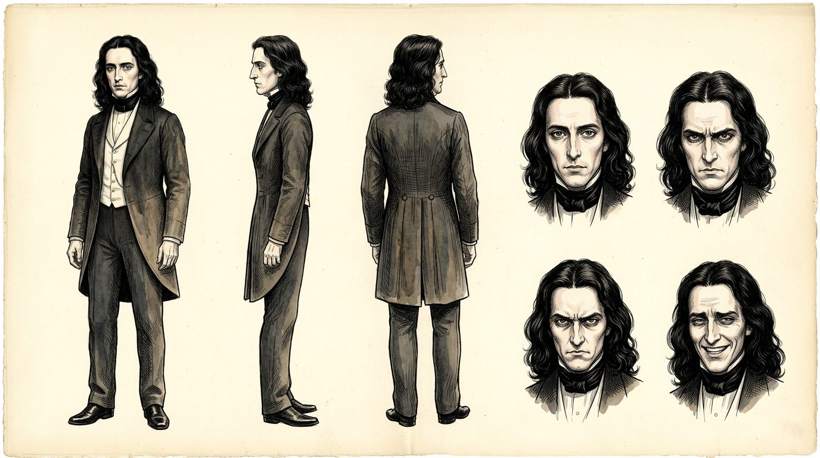
Film looks we will not copy
- Jim Caviezel 2002 film look
- Gérard Depardieu TV look
- Any named film look
Always book accurate. Every quote above was checked word for word against our stored copy of the text. Pictures are made with AI from the book's own description and checked by hand for film looks.