Macbeth 🔒 Members
Shakespeare. From Macbeth, William Shakespeare (died 1616). A Scottish general who murders his king to seize the throne, then descends into tyranny and madness.
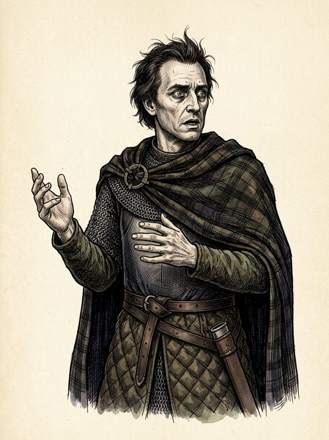
Age and build
A man of mature years and physical strength
“brave Macbeth (well he deserves that name), Disdaining Fortune, with his brandish’d steel, Which smok’d with bloody execution” (Macbeth, part 2)
Face and hair
Face that becomes pale with fear
“When mine are blanch’d with fear” (Macbeth, part 15)
Dress
The book is silent here, so we keep this plain and neutral.
Voice and speech
Speaks in elaborate, poetic language with philosophical reflection
“Tomorrow, and tomorrow, and tomorrow, Creeps in this petty pace from day to day” (Macbeth, part 25)
Uses imperious commands and rhetorical questions
“Speak, if you can;—what are you” (Macbeth, part 3)
Signature words
Glamis
“By Sinel’s death I know I am Thane of Glamis” (Macbeth, part 3)
Cawdor
“And Thane of Cawdor too; went it not so” (Macbeth, part 3)
Fear
“I have almost forgot the taste of fears” (Macbeth, part 25)
Blood
“It will have blood, they say, blood will have blood” (Macbeth, part 15)
Sleep
“Macbeth does murder sleep,”—the innocent sleep” (Macbeth, part 9)
Gait and mannerisms
Paces restlessly and gestures with agitation
“I am cabin’d, cribb’d, confin’d, bound in To saucy doubts and fears” (Macbeth, part 15)
Stares fixedly at visions and apparitions
“Pr’ythee, see there! Behold! look! lo! how say you” (Macbeth, part 15)
Strengths
Exceptional martial prowess and courage in battle
“brave Macbeth (well he deserves that name), Disdaining Fortune, with his brandish’d steel, Which smok’d with bloody execution, Like Valour’s minion, carv’d out his passage” (Macbeth, part 2)
Capable of decisive action and swift execution of plans
“From this moment The very firstlings of my heart shall be The firstlings of my hand” (Macbeth, part 18)
Intelligent and perceptive of political advantage
“I have bought Golden opinions from all sorts of people” (Macbeth, part 7)
Flaws
Consumed by vaulting ambition that overleaps itself
“Vaulting ambition, which o’erleaps itself And falls on th’ other” (Macbeth, part 7)
Susceptible to manipulation by his wife and supernatural forces
“This supernatural soliciting Cannot be ill; cannot be good” (Macbeth, part 3)
Tormented by guilt and paranoia after committing murder
“O, full of scorpions is my mind, dear wife” (Macbeth, part 13)
Becomes increasingly tyrannical and murderous to secure power
“I am in blood Stepp’d in so far that, should I wade no more, Returning were as tedious as go o’er” (Macbeth, part 15)
Traits
Ambitious and driven by desire for power
“The greatest is behind” (Macbeth, part 3)
Imaginative and prone to vivid, disturbing visions
“My thought, whose murder yet is but fantastical, Shakes so my single state of man” (Macbeth, part 3)
Capable of feigning loyalty and innocence
“False face must hide what the false heart doth know” (Macbeth, part 7)
Becomes increasingly isolated and desperate as his crimes mount
“I ’gin to be aweary of the sun” (Macbeth, part 25)
Lines in their own words
“So foul and fair a day I have not seen” (Macbeth, part 3)
“If it were done when ’tis done, then ’twere well It were done quickly” (Macbeth, part 7)
“I have done the deed.—Didst thou not hear a noise” (Macbeth, part 9)
“Out, out, brief candle! Life’s but a walking shadow; a poor player, That struts and frets his hour upon the stage” (Macbeth, part 25)
“I will not yield, To kiss the ground before young Malcolm’s feet” (Macbeth, part 27)
Reference sheet
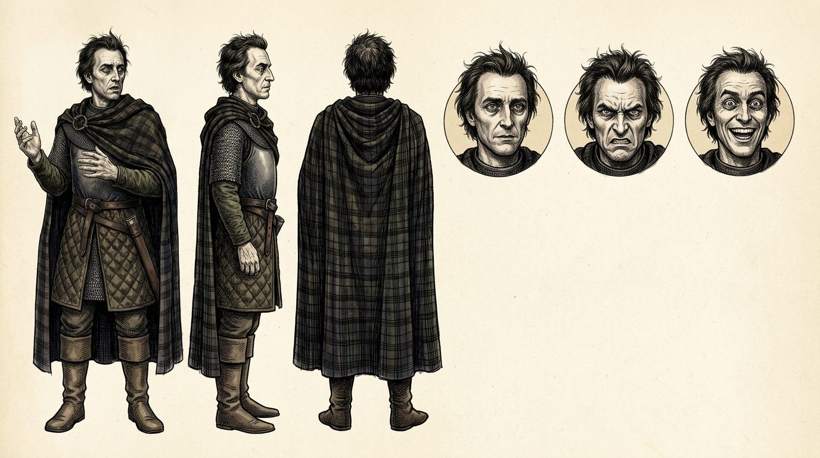
Film looks we will not copy
- Michael Fassbender 2015 film look
- Denzel Washington 2021 film look
- Orson Welles 1948 film look
Always book accurate. Every quote above was checked word for word against our stored copy of the text. Pictures are made with AI from the book's own description and checked by hand for film looks.