Loki 🔒 Members
Gods and heroes. From The Younger Edda, R.B. Anderson translation (1880), and The Poetic Edda, Henry Adams Bellows translation (1923). Loki is a trickster god of fire and cunning, originator of deceit and disgrace among gods and men, whose mischief-making brings both trouble and aid to the divine realm.
Care note: T: Marvel holds trade marks in its Loki designs. We draw only from the Eddas.
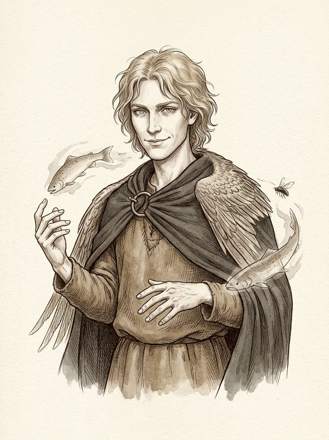
Age and build
Fair and beautiful of face
“Loke is fair and beautiful of face, but evil in disposition, and very fickle-minded” (Younger Edda Anderson, part 4)
Face and hair
Fair and beautiful countenance
“Loke is fair and beautiful of face, but evil in disposition, and very fickle-minded” (Younger Edda Anderson, part 4)
Dress
The book is silent here, so we keep this plain and neutral.
Voice and speech
Speaks with mockery and taunting
“Loki is famed | for his mockery foul, And the dwellers in heaven he hates” (Poetic Edda Bellows, part 16)
Addresses others directly and boldly
“Thirsty I come | into this thine hall, I, Lopt, from a journey long, To ask of the gods | that one should give Fair mead for a drink to me” (Poetic Edda Bellows, part 16)
Signature words
Called by the name Lopt
“I, Lopt, from a journey long” (Poetic Edda Bellows, part 16)
Referred to as son of Laufey
“Then Loki spake, | the son of Laufey” (Poetic Edda Bellows, part 18)
Called backbiter of the asas
“There is yet one who is numbered among the asas, but whom some call the backbiter of the asas” (Younger Edda Anderson, part 4)
Described as lover of ill
“One did I see | in the wet woods bound, A lover of ill, | and to Loki like” (Poetic Edda Bellows, part 2)
Gait and mannerisms
Transforms into a salmon to escape
“Oftentimes in the daytime he took on him the likeness of a salmon and concealed himself in Frananger Force” (Younger Edda Anderson, part 5)
Flies using feather-dress
“Then Loki flew, | and the feather-dress whirred, Till he left behind him | the home of the gods” (Poetic Edda Bellows, part 18)
Transforms into a fly
“He then transformed himself into a fly and tried every opening” (Younger Edda Anderson, part 10)
Strengths
Surpasses others in cunning craft
“He surpasses other men in the craft called cunning, and cheats in all things” (Younger Edda Anderson, part 4)
Often helps gods with cunning contrivances
“He has often brought the asas into great trouble, and often helped them out again, with his cunning contrivances” (Younger Edda Anderson, part 4)
Ingenious at devising stratagems
“Then he thought to himself what stratagems the asas might have recourse to in order to catch him” (Younger Edda Anderson, part 5)
Flaws
Evil in disposition and very fickle-minded
“Loke is fair and beautiful of face, but evil in disposition, and very fickle-minded” (Younger Edda Anderson, part 4)
Originator of deceit and disgrace
“He is the originator of deceit, and the disgrace of all gods and men” (Younger Edda Anderson, part 4)
Causes Balder's death through treachery
“When Loke, Laufey’s son, saw this, it displeased him very much that Balder was not scathed” (Younger Edda Anderson, part 5)
Mad and prone to wrath
“Mad art thou, Loki, | and little of wit, The wrath of Gefjun to rouse” (Poetic Edda Bellows, part 16)
Traits
Treacherous and deceitful
“Loki, the treacherous but ingenious son of Laufey” (Poetic Edda Bellows, part 3)
Mischief-maker and trouble-causer
“Loki, the trouble-maker, brought the mistletoe to Baldr’s blind brother, Hoth” (Poetic Edda Bellows, part 3)
Capable of shape-shifting
“Oftentimes in the daytime he took on him the likeness of a salmon and concealed himself in Frananger Force” (Younger Edda Anderson, part 5)
Produces monstrous offspring
“The wolf was fostered by the asas at home, and Tyr was the only one who had the courage to go to him and give him food” (Younger Edda Anderson, part 4)
Lines in their own words
Demands drink upon arrival
“Thirsty I come | into this thine hall, I, Lopt, from a journey long, To ask of the gods | that one should give Fair mead for a drink to me” (Poetic Edda Bellows, part 16)
Warns Thor about the giants
“Be silent, Thor, | and speak not thus; Else will the giants | in Asgarth dwell If thy hammer is brought not | home to thee” (Poetic Edda Bellows, part 18)
Offers to accompany Thor
“As thy maid-servant thither | I go with thee; We two shall haste | to the giants’ home” (Poetic Edda Bellows, part 18)
Boasts of his cunning theft
“Loke bragged of his chase, for he had secured an otter and a salmon with one throw” (Younger Edda Anderson, part 7)
Taunts others with their secrets
“Alone thou wert | if truly thou wouldst All men so shyly shun; But one do I know | full well, methinks, Who had thee from Hlorrithi’s arms” (Poetic Edda Bellows, part 16)
Reference sheet
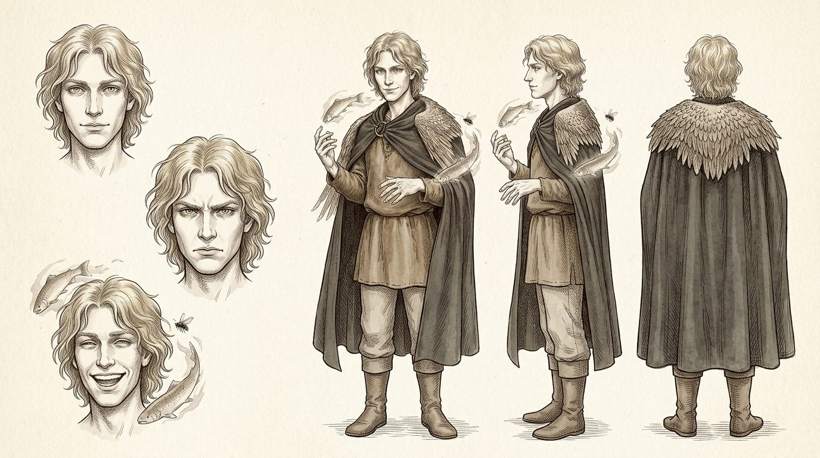
Film looks we will not copy
- Marvel Loki: green and gold costume, long curved horned helmet, black slicked hair
- Tom Hiddleston film look
- Any comic, film or game styling
Always book accurate. Every quote above was checked word for word against our stored copy of the text. Pictures are made with AI from the book's own description and checked by hand for film looks.