King Lear 🔒 Members
Shakespeare. From King Lear, William Shakespeare (died 1616). An aging king who divides his kingdom among his daughters based on flattery, then descends into madness when betrayed by them.
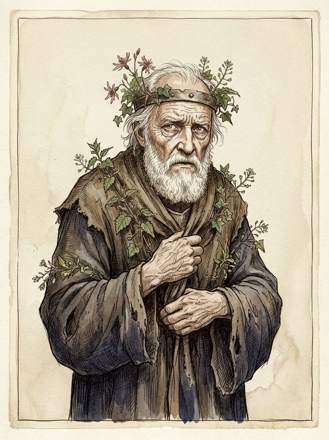
Age and build
Fourscore and upward in years
“I am a very foolish fond old man, Fourscore and upward, not an hour more nor less” (King Lear, part 23)
White-haired with age
“Singe my white head” (King Lear, part 11)
Face and hair
White beard and white hairs
“Ha! Goneril with a white beard! They flattered me like a dog; and told me I had white hairs in my beard” (King Lear, part 22)
Eyes that command authority
“When I do stare, see how the subject quakes” (King Lear, part 22)
Dress
Fantastically dressed with flowers in madness
“Lear, fantastically dressed up with flowers” (King Lear, part 22)
Wears royal garments and coronet as king
“Only we shall retain The name, and all the addition to a king” (King Lear, part 1)
Voice and speech
Uses elaborate metaphors and classical references
“How sharper than a serpent’s tooth it is To have a thankless child” (King Lear, part 4)
Speaks in passionate, torrential outbursts
“Blow, winds, and crack your cheeks! Rage! blow” (King Lear, part 11)
Signature words
Invokes Jupiter and Apollo
“Now, by Apollo” (King Lear, part 1)
Repeats 'nothing' obsessively
“Nothing will come of nothing: speak again” (King Lear, part 1)
Addresses daughters as 'daughter'
“What says our second daughter, Our dearest Regan, wife of Cornwall” (King Lear, part 1)
Uses 'O' as exclamatory prefix
“O, how this mother swells up toward my heart” (King Lear, part 9)
Swears by 'By Jupiter'
“By Jupiter, I swear no” (King Lear, part 9)
Gait and mannerisms
Strikes his own head in anguish
“O Lear, Lear, Lear! [Striking his head” (King Lear, part 4)
Kneels in mock supplication to his daughter
“Do you but mark how this becomes the house? ‘Dear daughter, I confess that I am old; [Kneeling” (King Lear, part 9)
Attempts to undress himself in madness
“Off, off, you lendings! Come, unbutton here” (King Lear, part 13)
Strengths
Commands absolute authority as king
“I do invest you jointly with my power, Pre-eminence, and all the large effects That troop with majesty” (King Lear, part 1)
Demonstrates capacity for forgiveness and reconciliation
“Pray you now, forget and forgive: I am old and foolish” (King Lear, part 23)
Shows tender love for Cordelia
“We two alone will sing like birds i’ the cage” (King Lear, part 25)
Flaws
Judges daughters by flattery rather than truth
“Which of you shall we say doth love us most? That we our largest bounty may extend Where nature doth with merit challenge” (King Lear, part 1)
Reacts with violent rage to contradiction
“Peace, Kent! Come not between the dragon and his wrath” (King Lear, part 1)
Banishes his most loyal and truthful daughter
“Here I disclaim all my paternal care, Propinquity and property of blood” (King Lear, part 1)
Lacks self-awareness about his own failings
“I have perceived a most faint neglect of late; which I have rather blamed as mine own jealous curiosity” (King Lear, part 4)
Traits
Imperious and accustomed to absolute obedience
“Attend the lords of France and Burgundy, Gloucester” (King Lear, part 1)
Prone to extreme emotional swings
“O, let me not be mad, not mad, sweet heaven! Keep me in temper” (King Lear, part 5)
Deeply wounded by ingratitude
“Ingratitude, thou marble-hearted fiend, More hideous when thou show’st thee in a child” (King Lear, part 4)
Struggles between reason and madness
“My wits begin to turn” (King Lear, part 11)
Lines in their own words
Testing his daughters' love
“Which of you shall we say doth love us most” (King Lear, part 1)
Rejecting Cordelia's honesty
“Nothing will come of nothing: speak again” (King Lear, part 1)
Cursing his daughter's ingratitude
“How sharper than a serpent’s tooth it is To have a thankless child” (King Lear, part 4)
Raging at the storm
“Blow, winds, and crack your cheeks! Rage! blow” (King Lear, part 11)
Recognizing his own folly
“I am a very foolish fond old man, Fourscore and upward” (King Lear, part 23)
Mourning Cordelia's death
“Howl, howl, howl, howl! O, you are men of stone” (King Lear, part 25)
Reference sheet
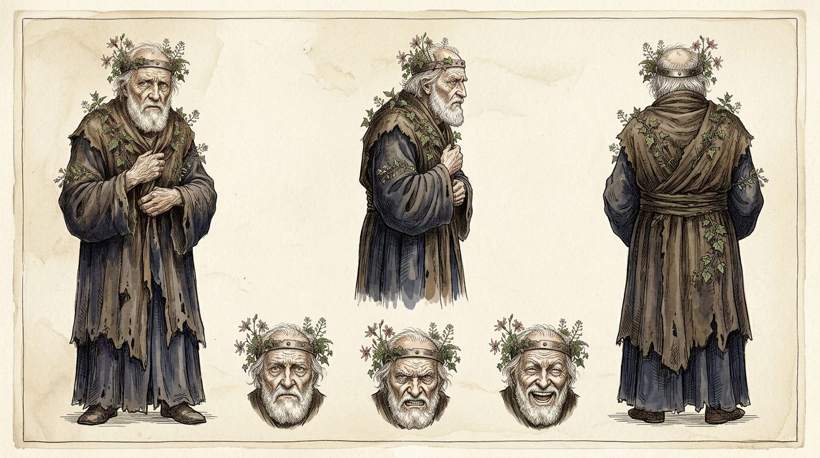
Film looks we will not copy
- Ian McKellen or Anthony Hopkins film looks
- Akira Kurosawa's Ran
Always book accurate. Every quote above was checked word for word against our stored copy of the text. Pictures are made with AI from the book's own description and checked by hand for film looks.