Jane Eyre 🔒 Members
Romance and manners. From Jane Eyre, Charlotte Brontë (1847). Jane Eyre is a poor, plain orphan governess who becomes a teacher and companion, eventually marrying her employer Mr. Rochester after overcoming trials of injustice and moral conviction.
Care note: C in early chapters: adult Jane only.
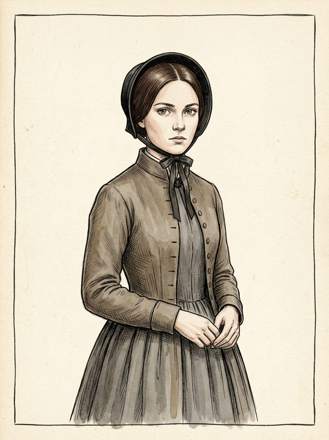
Age and build
Small and slight in stature as a child
“You’re not grown so very tall, Miss Jane, nor so very stout” (Jane Eyre, part 10)
Described as a little, pale girl
“I had the greatest inclination to follow up my advantage to purpose; but he was already with his mama” (Jane Eyre, part 4)
Petite and delicate in adulthood
“I never met your likeness. Jane, you please me, and you master me—you seem to submit, and I like the sense of pliancy you impart” (Jane Eyre, part 24)
Face and hair
Plain features, not conventionally beautiful
“you are not pretty any more than I am handsome, yet a puzzled air becomes you” (Jane Eyre, part 14)
Green eyes that are searching and expressive
“I had green eyes, reader; but you must excuse the mistake: for him they were new-dyed, I suppose” (Jane Eyre, part 24)
Hazel eyes described by Rochester
“Is this my pale, little elf? Is this my mustard-seed? This little sunny-faced girl with the dimpled cheek and rosy lips; the satin-smooth hazel hair, and the radiant hazel eyes” (Jane Eyre, part 24)
Clear forehead marked by nature with nobility
“nature, at least, has stamped her patent of nobility on this brow, Jane” (Jane Eyre, part 24)
Dress
Drab merino pelisse and cottage bonnet when visiting Gateshead
“now traversing the folds of my drab merino pelisse, and now lingering on the plain trimming of my cottage bonnet” (Jane Eyre, part 21)
Black stuff Lowood frock and straw bonnet from school days
“for not to me appertained that suit of wedding raiment; the pearl-coloured robe, the vapoury veil pendent from the usurped portmanteau” (Jane Eyre, part 25)
Voice and speech
Quiet, controlled manner of speaking
“it is not your forte to tell of yourself, but to listen while others talk of themselves” (Jane Eyre, part 14)
Voice constrained by Lowood discipline
“The Lowood constraint still clings to you somewhat; controlling your features, muffling your voice, and restricting your limbs” (Jane Eyre, part 14)
Capable of passionate, earnest speech when moved
“I think it is a glorious thing to have the hope of living with you, Edward, because I love you” (Jane Eyre, part 25)
Signature words
Frequent use of 'Well, sir?'
“It is a small phrase very frequent with you; and which many a time has drawn me on and on through interminable talk” (Jane Eyre, part 27)
Direct address to Rochester as 'sir'
“Yes, sir, Jane Eyre” (Jane Eyre, part 3)
Formal address as 'Mr. Rochester'
“I don’t call you handsome, sir, though I love you most dearly: far too dearly to flatter you” (Jane Eyre, part 24)
Gait and mannerisms
Restless, eager movements when curious
“You open your eyes like an eager bird, and make every now and then a restless movement, as if answers in speech did not flow fast enough for you” (Jane Eyre, part 27)
Hesitant, uncertain manner in Rochester's presence
“there was a curious hesitation in your manner: you glanced at me with a slight trouble—a hovering doubt” (Jane Eyre, part 27)
Tendency to pace and dream when alone
“you lapsed at once into deep reverie: you betook yourself slowly to pace the gallery” (Jane Eyre, part 27)
Strengths
Moral courage and integrity
“I read a sincere nature in your ardent eyes and on your clear front” (Jane Eyre, part 8)
Capacity for hard work and diligence
“you could perform it with capacity and tact: you could win while you controlled” (Jane Eyre, part 34)
Ability to listen and understand others
“people will instinctively find out, as I have done, that it is not your forte to tell of yourself, but to listen while others talk of themselves” (Jane Eyre, part 14)
Resolute independence and self-reliance
“you are not naturally austere, any more than I am naturally vicious” (Jane Eyre, part 14)
Flaws
Passionate and prone to violent anger when provoked
“you are passionate, Jane, that you must allow” (Jane Eyre, part 4)
Tendency to be reserved and withdrawn
“you are not naturally austere, any more than I am naturally vicious. The Lowood constraint still clings to you somewhat” (Jane Eyre, part 14)
Susceptible to anxiety and nervous distress
“This is hypochondria, Jane. You have been over-excited, or over-fatigued” (Jane Eyre, part 25)
Accused of deceit by Mrs. Reed
“a tendency to deceit. I mention this in your hearing, Jane, that you may not attempt to impose on Mr. Brocklehurst” (Jane Eyre, part 4)
Traits
Honest and truthful in character
“I know you are of this charge which Mr. Brocklehurst has weakly and pompously repeated at second-hand from Mrs. Reed; for I read a sincere nature in your ardent eyes” (Jane Eyre, part 8)
Generous and willing to sacrifice
“I recognised a soul that revelled in the flame and excitement of sacrifice” (Jane Eyre, part 34)
Docile and obedient when treated with respect
“Jane, you are docile, diligent, disinterested, faithful, constant, and courageous; very gentle, and very heroic” (Jane Eyre, part 34)
Deeply principled and guided by conscience
“I have attended to the claims of conscience, the counsels of reason” (Jane Eyre, part 19)
Lines in their own words
“I am Jane Eyre: I have found you out—I am come back to you” (Jane Eyre, part 37)
“Do you like this sunrise, Jane? That sky with its high and light clouds which are sure to melt away as the day waxes warm” (Jane Eyre, part 20)
“I think it is a glorious thing to have the hope of living with you, Edward, because I love you” (Jane Eyre, part 25)
Reference sheet
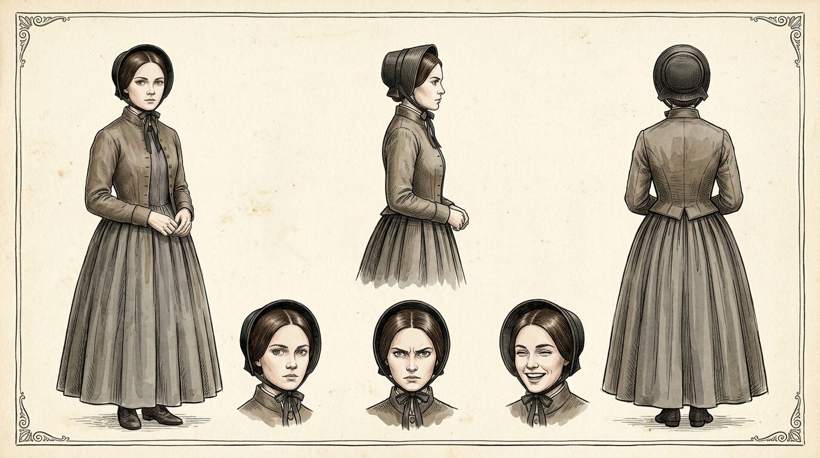
Film looks we will not copy
- Joan Fontaine, Mia Wasikowska or Ruth Wilson looks
Always book accurate. Every quote above was checked word for word against our stored copy of the text. Pictures are made with AI from the book's own description and checked by hand for film looks.