Iago 🔒 Members
Shakespeare. From Othello, William Shakespeare (died 1616). Othello's ancient (ensign), a manipulative schemer who orchestrates the tragedy through calculated deception and poisonous insinuation.
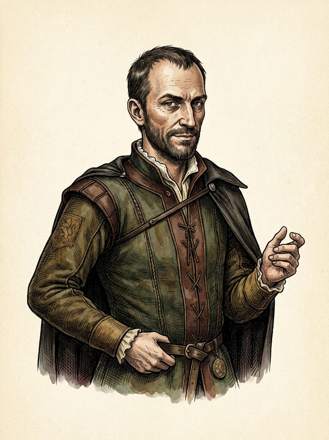
Age and build
The book is silent here, so we keep this plain and neutral.
Face and hair
The book is silent here, so we keep this plain and neutral.
Dress
The book is silent here, so we keep this plain and neutral.
Voice and speech
Speaks with calculated restraint, using questions and hesitations to plant doubt
“Nothing, my lord; or if—I know not what” (Othello, part 7)
Employs crude, vivid imagery when provoked or manipulating
“Even now, now, very now, an old black ram Is tupping your white ewe” (Othello, part 1)
Uses philosophical rhetoric to justify base actions
“Our bodies are gardens, to the which our wills are gardeners” (Othello, part 3)
Signature words
I am not what I am—his declaration of duplicity
“I am not what I am” (Othello, part 1)
Put money in thy purse—repeated mercenary refrain
“Put money in thy purse” (Othello, part 3)
Zounds—his frequent oath
“Zounds, sir, you’re robb’d” (Othello, part 1)
Villain/villainy—self-aware acknowledgement
“And what’s he then, that says I play the villain” (Othello, part 5)
Knavery—his craft and cunning
“Knavery’s plain face is never seen till us’d” (Othello, part 4)
Gait and mannerisms
Performs elaborate courtesy and deference in public
“Come on, come on; you are pictures out of doors, Bells in your parlours, wild-cats in your kitchens” (Othello, part 4)
Uses asides to reveal true thoughts while maintaining false front
“Aside.] He takes her by the palm. Ay, well said, whisper. With as little a web as this will I ensnare as great a fly as Cassio” (Othello, part 4)
Physically aggressive when thwarted, snatching the handkerchief
“Snatching it.] Why, what’s that to you” (Othello, part 7)
Strengths
Master manipulator who reads others' weaknesses with precision
“Thus do I ever make my fool my purse. For I mine own gain’d knowledge should profane If I would time expend with such a snipe But for my sport and profit” (Othello, part 3)
Understands Othello's nature and exploits his openness
“The Moor is of a free and open nature That thinks men honest that but seem to be so, And will as tenderly be led by the nose As asses are” (Othello, part 3)
Skilled at appearing helpful while sowing destruction
“I will go on. I lay with Cassio lately, And being troubled with a raging tooth, I could not sleep” (Othello, part 7)
Capable of rapid tactical improvisation
“If consequence do but approve my dream, My boat sails freely, both with wind and stream” (Othello, part 5)
Flaws
Consumed by resentment over being passed over for promotion
“Despise me if I do not. Three great ones of the city, In personal suit to make me his lieutenant, Off-capp’d to him; and by the faith of man, I know my price, I am worth no worse a place” (Othello, part 1)
Obsessed with suspected infidelity, driven by jealous suspicion
“I do suspect the lusty Moor Hath leap’d into my seat. The thought whereof Doth, like a poisonous mineral, gnaw my inwards” (Othello, part 4)
Ultimately undone by his own schemes and exposed
“Demand me nothing. What you know, you know. From this time forth I never will speak word” (Othello, part 13)
Capable of sudden violence when cornered
“Iago stabs Emilia and then runs out” (Othello, part 13)
Traits
Cynical about human nature and virtue
“Virtue! a fig! ’Tis in ourselves that we are thus or thus” (Othello, part 3)
Contemptuous of romantic love and emotional attachment
“Ere I would say I would drown myself for the love of a guinea-hen, I would change my humanity with a baboon” (Othello, part 3)
Pragmatic and transactional in all relationships
“I follow him to serve my turn upon him: We cannot all be masters, nor all masters Cannot be truly follow’d” (Othello, part 1)
Willing to commit murder for profit and revenge
“No, he must die. But so, I hear him coming” (Othello, part 12)
Lines in their own words
His declaration of hidden nature
“I am not what I am” (Othello, part 1)
Feigned concern masking manipulation
“O, beware, my lord, of jealousy; It is the green-ey’d monster which doth mock The meat it feeds on” (Othello, part 7)
Cynical dismissal of Roderigo's despair
“Why, go to bed and sleep” (Othello, part 3)
Feigned outrage at being accused
“O grace! O heaven defend me! Are you a man? Have you a soul or sense” (Othello, part 7)
Final defiant silence
“Demand me nothing. What you know, you know. From this time forth I never will speak word” (Othello, part 13)
Reference sheet
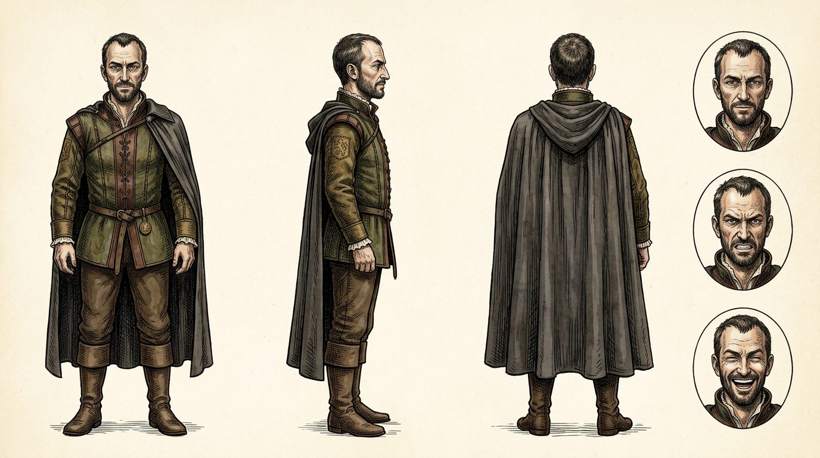
Film looks we will not copy
- Kenneth Branagh 1995 film look
- Disney's Aladdin parrot Iago, a Disney trade mark
Always book accurate. Every quote above was checked word for word against our stored copy of the text. Pictures are made with AI from the book's own description and checked by hand for film looks.