Hamlet 🔒 Members
Shakespeare. From Hamlet, William Shakespeare (died 1616). Young Prince of Denmark, melancholic and introspective, burdened by his father's murder and his mother's hasty remarriage.
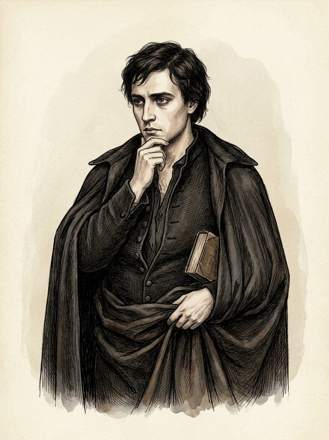
Age and build
described as young
“Now for ourself and for this time of meeting: Thus much the business is: we have here writ To Norway, uncle of young Fortinbras” (Hamlet, part 2)
fat and scant of breath in final scene
“He’s fat, and scant of breath” (Hamlet, part 20)
Face and hair
pale complexion
“Pale as his shirt, his knees knocking each other” (Hamlet, part 6)
Dress
wears inky cloak and customary suits of solemn black
“Tis not alone my inky cloak, good mother, Nor customary suits of solemn black” (Hamlet, part 2)
appears dishevelled when visiting Ophelia
“with his doublet all unbrac’d, No hat upon his head, his stockings foul’d, Ungart’red, and down-gyved to his ankle” (Hamlet, part 6)
wears sea-gown when aboard ship
“Up from my cabin, My sea-gown scarf’d about me, in the dark” (Hamlet, part 20)
Voice and speech
speaks with philosophical depth and wordplay
“There are more things in heaven and earth, Horatio, Than are dreamt of in your philosophy” (Hamlet, part 5)
uses elaborate metaphors and classical allusions
“What a piece of work is man, how noble in reason, how infinite in faculties” (Hamlet, part 7)
prone to dark humour and bitter wit
“Thrift, thrift, Horatio! The funeral bak’d meats Did coldly furnish forth the marriage tables” (Hamlet, part 2)
Signature words
frequently says 'seems' and 'seems not'
“Seems, madam! Nay, it is; I know not seems” (Hamlet, part 2)
uses 'good' repeatedly in address
“My excellent good friends! How dost thou, Guildenstern” (Hamlet, part 7)
invokes 'God' and 'heaven' frequently
“O God! O God! How weary, stale, flat, and unprofitable” (Hamlet, part 2)
uses 'marry' as an exclamation
“Ay marry is’t; And to my mind, though I am native here” (Hamlet, part 4)
says 'words, words, words' dismissively
“Words, words, words” (Hamlet, part 7)
uses 'nay' in contradiction
“Nay, but to live In the rank sweat of an enseamed bed” (Hamlet, part 11)
Gait and mannerisms
appears distracted and melancholic
“I have of late, but wherefore I know not, lost all my mirth, forgone all custom of exercises” (Hamlet, part 7)
exhibits erratic behaviour and antic disposition
“As I perchance hereafter shall think meet To put an antic disposition on” (Hamlet, part 5)
gestures with hands when speaking passionately
“Nor do not saw the air too much with your hand, thus, but use all gently” (Hamlet, part 9)
Strengths
highly intelligent and philosophical
“What a piece of work is man, how noble in reason, how infinite in faculties, in form and moving” (Hamlet, part 7)
capable of keen observation and manipulation
“I’ll observe his looks; I’ll tent him to the quick. If he but blench, I know my course” (Hamlet, part 7)
skilled at deception and forgery
“Devis’d a new commission, wrote it fair: I once did hold it, as our statists do, A baseness to write fair” (Hamlet, part 20)
Flaws
paralysed by indecision and overthinking
“Thus conscience does make cowards of us all, And thus the native hue of resolution Is sicklied o’er with the pale cast of thought” (Hamlet, part 8)
prone to violent outbursts and cruelty
“I am very proud, revengeful, ambitious, with more offences at my beck than I have thoughts to put them in” (Hamlet, part 8)
mistrusts those close to him
“Whom I will trust as I will adders fang’d,— They bear the mandate, they must sweep my way And marshal me to knavery” (Hamlet, part 11)
struggles with depression and suicidal ideation
“O that this too too solid flesh would melt, Thaw, and resolve itself into a dew” (Hamlet, part 2)
acts rashly without full consideration
“Rashly, And prais’d be rashness for it,—let us know, Our indiscretion sometime serves us well” (Hamlet, part 20)
Traits
deeply melancholic and world-weary
“How weary, stale, flat, and unprofitable Seem to me all the uses of this world” (Hamlet, part 2)
obsessed with death and mortality
“To be, or not to be, that is the question: Whether ’tis nobler in the mind to suffer” (Hamlet, part 8)
values honesty and authenticity
“Give me that man That is not passion’s slave, and I will wear him In my heart’s core, ay, in my heart of heart, As I do thee” (Hamlet, part 9)
deeply troubled by his mother's sexuality
“O most wicked speed, to post With such dexterity to incestuous sheets” (Hamlet, part 2)
believes in divine providence
“There’s a divinity that shapes our ends, Rough-hew them how we will” (Hamlet, part 20)
Lines in their own words
on his mother's remarriage
“A little more than kin, and less than kind” (Hamlet, part 2)
on mortality, holding Yorick's skull
“Alas, poor Yorick. I knew him, Horatio, a fellow of infinite jest, of most excellent fancy” (Hamlet, part 19)
on acceptance of fate
“The readiness is all. Since no man has aught of what he leaves, what is’t to leave betimes” (Hamlet, part 20)
final words before death
“The rest is silence” (Hamlet, part 20)
on his feigned madness
“I am but mad north-north-west. When the wind is southerly, I know a hawk from a handsaw” (Hamlet, part 7)
Reference sheet
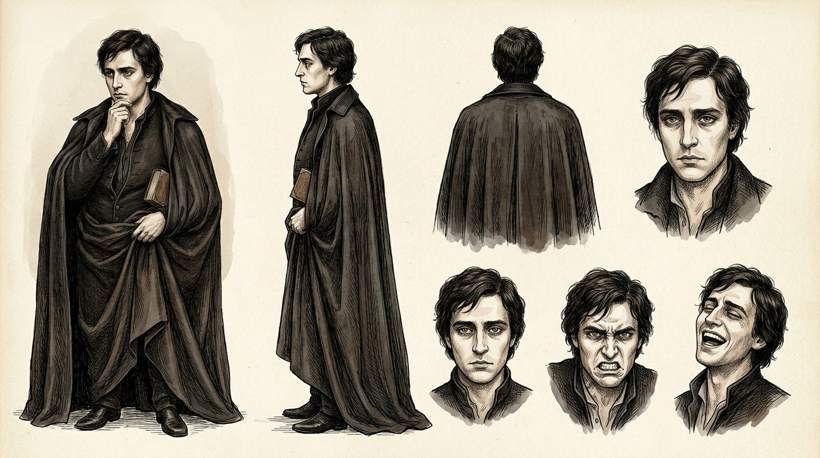
Film looks we will not copy
- Laurence Olivier 1948 film look: bleached blond hair
- Kenneth Branagh 1996 film look: blond hair and white military uniform
- Disney's The Lion King
- Skull held at arm's length as a poster pose with a film actor's face
Always book accurate. Every quote above was checked word for word against our stored copy of the text. Pictures are made with AI from the book's own description and checked by hand for film looks.