Count Dracula
Gothic horror. From Dracula, Bram Stoker (1897). Count Dracula is an ancient Székely nobleman and vampire who seeks to establish himself in England but is ultimately pursued and destroyed by those he has wronged.
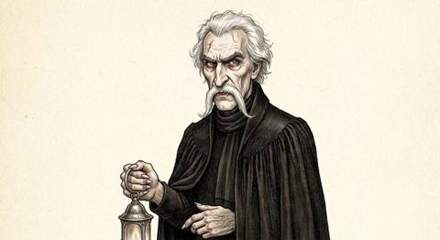
Age and build
Tall and thin in appearance
“By her side stood a tall, thin man, clad in black” (Dracula, chapter 21)
Possesses great physical strength
“He has the strength of many of his hand—witness again Jonathan when he shut the door against the wolfs, and when he help him from the diligence too” (Dracula, chapter 18)
Face and hair
White moustache, later darkened
“He grew excited as he spoke, and walked about the room pulling his great white moustache and grasping anything on which he laid his hands as though he would crush it by main strength” (Dracula, chapter 3)
High aquiline nose with wide nostrils
“His eyes flamed red with devilish passion; the great nostrils of the white aquiline nose opened wide and quivered at the edge; and the white sharp teeth, behind the full lips of the blood-dripping mouth, champed together like those of a wild beast” (Dracula, chapter 21)
Protuberant teeth, long and sharp canines
“with a grim sort of smile, which showed more than he had yet done his protuberant teeth, sat himself down again on his own side of the fireplace” (Dracula, chapter 2)
Red eyes with demonic expression
“The red light in them was lurid, as if the flames of hell-fire blazed behind them. His face was deathly pale, and the lines of it were hard like drawn wires; the thick eyebrows that met over the nose now seemed like a heaving bar of white-hot metal” (Dracula, chapter 3)
Red scar on forehead
“in every way, even to the scar on his forehead” (Dracula, chapter 21)
Pale complexion that becomes greenish-yellow
“His waxen hue became greenish-yellow by the contrast of his burning eyes, and the red scar on the forehead showed on the pallid skin like a palpitating wound” (Dracula, chapter 23)
Hair changes from white to dark iron-grey when gorged with blood
“the white hair and moustache were changed to dark iron-grey; the cheeks were fuller, and the white skin seemed ruby-red underneath” (Dracula, chapter 4)
Dress
Clad in black clothing
“By her side stood a tall, thin man, clad in black” (Dracula, chapter 21)
Wears a cloak that spreads like wings
“face down with his cloak spreading out around him like great wings” (Dracula, chapter 3)
Carries bank-notes and gold in his coat
“A second less and the trenchant blade had shorne through his heart. As it was, the point just cut the cloth of his coat, making a wide gap whence a bundle of bank-notes and a stream of gold fell out” (Dracula, chapter 23)
Voice and speech
Speaks German worse than Jonathan's own
“he said in German worse than my own” (Dracula, chapter 1)
Speaks English thoroughly and courteously
“But, Count,” I said, “you know and speak English thoroughly!” He bowed gravely” (Dracula, chapter 2)
Harsh, metallic whisper when calling wolves
“I heard the voice of the Count calling in his harsh, metallic whisper” (Dracula, chapter 4)
Low whisper that cuts through air and rings round room
“In a voice which, though low and almost in a whisper seemed to cut through the air and then ring round the room he said” (Dracula, chapter 3)
Speaks in smooth, resistless manner
“there was that in his eyes and in his bearing which made me remember that I was a prisoner, and that if I wished it I could have no choice. The Count saw his victory in my bow, and his mastery in the trouble of my face, for he began at once to use them, but in his own smooth, resistless way” (Dracula, chapter 3)
Signature words
Uses 'we' when speaking of his house and race
“Whenever he spoke of his house he always said “we,” and spoke almost in the plural, like a king speaking” (Dracula, chapter 3)
Addresses Jonathan as 'my good young friend'
“I pray you, my good young friend, that you will not discourse of things other than business in your letters” (Dracula, chapter 3)
Uses courtly greeting 'I bid you welcome'
“I am Dracula; and I bid you welcome, Mr. Harker, to my house” (Dracula, chapter 2)
Addresses others as 'friend' in formal manner
“To-morrow, my friend, we must part” (Dracula, chapter 4)
Uses 'Aha!' as exclamation
“Aha!” he said; “still at your books” (Dracula, chapter 2)
Says 'Come' as imperative command
“Come,” he said at last, “tell me of London and of the house which you have procured for me” (Dracula, chapter 2)
Gait and mannerisms
Crawls down castle wall like a lizard
“I saw the fingers and toes grasp the corners of the stones, worn clear of the mortar by the stress of years, and by thus using every projection and inequality move downwards with considerable speed, just as a lizard moves along a wall” (Dracula, chapter 3)
Moves with panther-like leap into room
“Suddenly with a single bound he leaped into the room, winning a way past us before any of us could raise a hand to stay him. There was something so panther-like in the movement—something so unhuman, that it seemed to sober us all from the shock of his coming” (Dracula, chapter 23)
Bows in courtly manner
“He bowed in a courtly way as he replied” (Dracula, chapter 2)
Grasps things as though to crush them
“He grew excited as he spoke, and walked about the room pulling his great white moustache and grasping anything on which he laid his hands as though he would crush it by main strength” (Dracula, chapter 3)
Kisses hand in gesture of triumph
“The last I saw of Count Dracula was his kissing his hand to me; with a red light of triumph in his eyes, and with a smile that Judas in hell might be proud of” (Dracula, chapter 4)
Strengths
Possesses superhuman strength
“He has the strength of many of his hand—witness again Jonathan when he shut the door against the wolfs, and when he help him from the diligence too” (Dracula, chapter 18)
Can transform into wolf form
“He can transform himself to wolf, as we gather from the ship arrival in Whitby, when he tear open the dog; he can be as bat, as Madam Mina saw him on the window at Whitby, and as friend John saw him fly from this so near house, and as my friend Quincey saw him at the window of Miss Lucy” (Dracula, chapter 18)
Can travel in mist form
“He can come in mist which he create—that noble ship’s captain proved him of this; but, from what we know, the distance he can make this mist is limited, and it can only be round himself” (Dracula, chapter 18)
Can see in darkness
“He can see in the dark—no small power this, in a world which is one half shut from the light” (Dracula, chapter 18)
Commands wolves and rats
“That horrid thing has the wolves and the rats and his own kind to help him, so I suppose he isn’t above trying to use a respectable lunatic” (Dracula, chapter 19)
Possesses clever and cunning mind
“He must, indeed, have been that Voivode Dracula who won his name against the Turk, over the great river on the very frontier of Turkey-land. If it be so, then was he no common man; for in that time, and for centuries after, he was spoken of as the cleverest and the most cunning, as well as the bravest of the sons of the ‘land beyond the forest” (Dracula, chapter 18)
Can grow younger when fed on blood
“Even more, we have seen amongst us that he can even grow younger; that his vital faculties grow strenuous, and seem as though they refresh themselves when his special pabulum is plenty” (Dracula, chapter 18)
Casts no shadow and has no reflection
“He throws no shadow; he make in the mirror no reflect, as again Jonathan observe” (Dracula, chapter 18)
Flaws
Cannot enter a place unless invited by household member
“He may not enter anywhere at the first, unless there be some one of the household who bid him to come; though afterwards he can come as he please” (Dracula, chapter 18)
Power ceases at coming of day
“His power ceases, as does that of all evil things, at the coming of the day” (Dracula, chapter 18)
Cannot cross running water except at slack or flood tide
“It is said, too, that he can only pass running water at the slack or the flood of the tide” (Dracula, chapter 18)
Affected by sacred objects like crucifix
“to them he is nothing, but in their presence he take his place far off and silent with respect” (Dracula, chapter 18)
Affected by garlic
“there are things which so afflict him that he has no power, as the garlic that we know of” (Dracula, chapter 18)
Has child-brain despite centuries of existence
“his child-brain that lie in his tomb for centuries, that grow not yet to our stature, and that do only work selfish and therefore small” (Dracula, chapter 25)
Criminal mind limited to repeating same crime
“The criminal always work at one crime—that is the true criminal who seems predestinate to crime, and who will of none other. This criminal has not full man-brain. He is clever and cunning and resourceful; but he be not of man-stature as to brain. He be of child-brain in much” (Dracula, chapter 25)
Must return to his earth-boxes to rest
“when he have his earth-home, his coffin-home, his hell-home, the place unhallowed, as we saw when he went to the grave of the suicide at Whitby; still at other time he can only change when the time come” (Dracula, chapter 18)
Traits
Proud of his ancient Székely lineage
“We Szekelys have a right to be proud, for in our veins flows the blood of many brave races who fought as the lion fights, for lordship” (Dracula, chapter 3)
Speaks of his house and race with royal plural
“Whenever he spoke of his house he always said “we,” and spoke almost in the plural, like a king speaking” (Dracula, chapter 3)
Intensely interested in acquiring knowledge
“He was interested in everything, and asked me a myriad questions about the place and its surroundings. He clearly had studied beforehand all he could get on the subject of the neighbourhood, for he evidently at the end knew very much more than I did” (Dracula, chapter 2)
Methodical and systematic in planning
“Everything had been carefully thought out, and done systematically and with precision. He seemed to have been prepared for every obstacle which might be placed by accident in the way of his intentions being carried out. To use an Americanism, he had “taken no chances,” and the absolute accuracy with which his instructions were fulfilled, was simply the logical result of his care” (Dracula, chapter 17)
Possesses demoniac fury when angered
“When the Count saw my face, his eyes blazed with a sort of demoniac fury, and he suddenly made a grab at my throat” (Dracula, chapter 2)
Shows malicious grin and hellish rage
“There was a mocking smile on the bloated face which seemed to drive me mad. This was the being I was helping to transfer to London, where, perhaps, for centuries to come he might, amongst its teeming millions, satiate his lust for blood, and create a new and ever-widening circle of semi-demons to batten on the helpless” (Dracula, chapter 4)
Feeds on blood to sustain and rejuvenate himself
“The vampire live on, and cannot die by mere passing of the time; he can flourish when that he can fatten on the blood of the living” (Dracula, chapter 18)
Lines in their own words
Welcoming Jonathan to his castle
“I am Dracula; and I bid you welcome, Mr. Harker, to my house. Come in; the night air is chill, and you must need to eat and rest” (Dracula, chapter 2)
Instructing Jonathan on discretion in letters
“I pray you, my good young friend, that you will not discourse of things other than business in your letters” (Dracula, chapter 3)
Speaking of his ancient race and pride
“We Szekelys have a right to be proud, for in our veins flows the blood of many brave races who fought as the lion fights, for lordship” (Dracula, chapter 3)
Announcing his departure from England
“To-morrow, my friend, we must part. You return to your beautiful England, I to some work which may have such an end that we may never meet” (Dracula, chapter 4)
Asking about London and the house
“Come,” he said at last, “tell me of London and of the house which you have procured for me” (Dracula, chapter 2)
Reference sheet
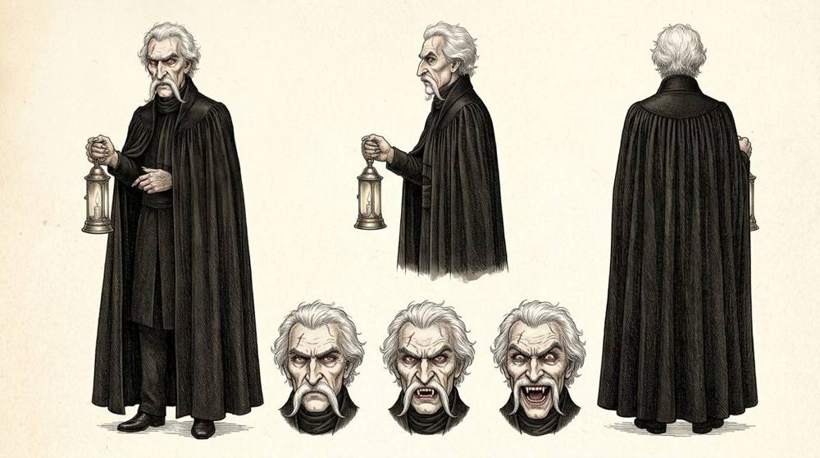
Film looks we will not copy
- Bela Lugosi look from the 1931 Universal film: slicked black hair with a widow's peak, clean shaven face, tuxedo, medallion, high stand up collar cape with red lining
- Christopher Lee Hammer film look
- Gary Oldman 1992 film look: grey bouffant hair, red armour, top hat and blue glasses
- Children's TV counts and cereal box vampires
- Bat wing collars and plastic fangs of fancy dress
Every quote above was checked word for word against our stored copy of the text. Pictures are made with AI from the book's own description and checked by hand for film looks.