Dorian Gray 🔒 Members
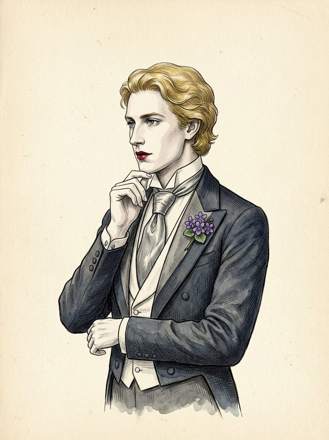
Gothic and horror. From The Picture of Dorian Gray, Oscar Wilde (1890). A beautiful young man whose portrait ages while he remains eternally youthful, leading a life of increasing corruption and moral decay.
Age and build
Graceful and slender build
“the grace of his figure broken and deformed” (The Picture Of Dorian Gray, part 2)
Face and hair
Golden hair
“Dorian Gray lifted his golden head from the pillow, and with pallid face and tear-stained eyes” (The Picture Of Dorian Gray, part 2)
Blue eyes
“opening his blue eyes in wonder” (The Picture Of Dorian Gray, part 4)
Pale complexion
“with pallid face and tear-stained eyes, looked at him” (The Picture Of Dorian Gray, part 2)
Dress
Wears perfume and elegant accessories
“putting some perfume on his handkerchief out of a large, gold-topped bottle that stood on the table” (The Picture Of Dorian Gray, part 4)
Wears button-hole flowers
“exquisitely dressed and wearing a large button-hole of Parma violets” (The Picture Of Dorian Gray, part 15)
Wears evening dress
“two young men in evening dress passed him” (The Picture Of Dorian Gray, part 20)
Dresses in fashionable neckties
“He has already copied your neckties, and has begged me to introduce him to you” (The Picture Of Dorian Gray, part 19)
Voice and speech
Beautiful, musical voice
“And he had such a beautiful voice” (The Picture Of Dorian Gray, part 2)
Low, languid voice that fascinates
“There was something in his low languid voice that was absolutely fascinating” (The Picture Of Dorian Gray, part 2)
Speaks with musical utterance
“lingering over his name with long-drawn music in her voice, as though it were sweeter than honey” (The Picture Of Dorian Gray, part 7)
Signature words
Frequently uses 'Harry' when addressing Lord Henry
“Don’t go to the theatre to-night, Dorian,” said Hallward. “Stop and dine with me” (The Picture Of Dorian Gray, part 2)
Uses 'my dear' in familiar address
“My dear Harry, we either lunch or sup together every day” (The Picture Of Dorian Gray, part 4)
Expresses wonder and curiosity
“What can it matter?” cried Dorian Gray, laughing” (The Picture Of Dorian Gray, part 2)
Uses 'I wonder' to express contemplation
“I wonder is that really so, Harry?” said Dorian Gray” (The Picture Of Dorian Gray, part 4)
Expresses petulance and impatience
“What is it all about?” cried Dorian in his petulant way” (The Picture Of Dorian Gray, part 12)
Uses 'Basil' when addressing the painter
“Basil, I am tired of standing,” cried Dorian Gray suddenly” (The Picture Of Dorian Gray, part 2)
Gait and mannerisms
Moves with grace and elegance
“Dorian Gray stepped up on the dais with the air of a young Greek martyr” (The Picture Of Dorian Gray, part 2)
Makes expressive gestures with hands
“His cool, white, flowerlike hands, even, had a curious charm. They moved, as he spoke, like music” (The Picture Of Dorian Gray, part 2)
Frequently laughs and smiles
“Dorian Gray laughed, and tossed his head” (The Picture Of Dorian Gray, part 6)
Blushes easily when embarrassed or bold
“flushing at his own boldness, then stepped up on the platform” (The Picture Of Dorian Gray, part 2)
Strengths
Possesses extraordinary physical beauty
“The sense of his own beauty came on him like a revelation” (The Picture Of Dorian Gray, part 2)
Charming and persuasive personality
“He charmed his listeners out of themselves, and they followed his pipe, laughing” (The Picture Of Dorian Gray, part 3)
Capable of genuine affection and tenderness
“I love Sibyl Vane. I want to place her on a pedestal of gold and to see the world worship the woman who is mine” (The Picture Of Dorian Gray, part 6)
Intelligent and perceptive
“You have explained me to myself, Harry,” he murmured with something of a sigh of relief” (The Picture Of Dorian Gray, part 8)
Flaws
Becomes cruel and callous after Sibyl's death
“with his beautiful eyes, looked down at her, and his chiselled lips curled in exquisite disdain” (The Picture Of Dorian Gray, part 7)
Incapable of sustaining genuine emotion
“I cannot repeat an emotion. No one can, except sentimentalists” (The Picture Of Dorian Gray, part 9)
Becomes increasingly selfish and indifferent to others' suffering
“One’s days were too brief to take the burden of another’s errors on one’s shoulders” (The Picture Of Dorian Gray, part 16)
Corrupts those around him through his influence
“You have filled them with a madness for pleasure. They have gone down into the depths” (The Picture Of Dorian Gray, part 12)
Becomes obsessed with hiding his portrait and his sins
“I am afraid it is rather heavy,” murmured Dorian as he unlocked the door that opened into the room that was to keep for him the curious secret of his life” (The Picture Of Dorian Gray, part 10)
Traits
Vain and obsessed with his own beauty
“If it were I who was to be always young, and the picture that was to grow old! For that—for that—I would give everything” (The Picture Of Dorian Gray, part 2)
Easily influenced by others, particularly Lord Henry
“To a large extent the lad was his own creation” (The Picture Of Dorian Gray, part 4)
Experiences moments of genuine remorse and desire for redemption
“I want to be good. I can’t bear the idea of my soul being hideous” (The Picture Of Dorian Gray, part 8)
Becomes increasingly desperate and haunted by his crimes
“Life had suddenly become too hideous a burden for him to bear” (The Picture Of Dorian Gray, part 18)
Lines in their own words
Expressing wonder at his own beauty
“How sad it is! I shall grow old, and horrible, and dreadful. But this picture will remain always young” (The Picture Of Dorian Gray, part 2)
Defending his love for Sibyl Vane
“Harry! Sibyl Vane is sacred” (The Picture Of Dorian Gray, part 4)
Expressing callousness after Sibyl's death
“So I have murdered Sibyl Vane,” said Dorian Gray, half to himself, “murdered her as surely as if I had cut her little throat with a knife” (The Picture Of Dorian Gray, part 8)
Attempting to justify his actions
“You ask me why Berwick leaves a room when I enter it. It is because I know everything about his life, not because he knows anything about mine” (The Picture Of Dorian Gray, part 12)
Expressing desire for escape and redemption
“I wish I could love,” cried Dorian Gray with a deep note of pathos in his voice. “But I seem to have lost the passion and forgotten the desire” (The Picture Of Dorian Gray, part 18)
Claiming to have begun reform
“No, Harry, I have done too many dreadful things in my life. I am not going to do any more. I began my good actions yesterday” (The Picture Of Dorian Gray, part 19)
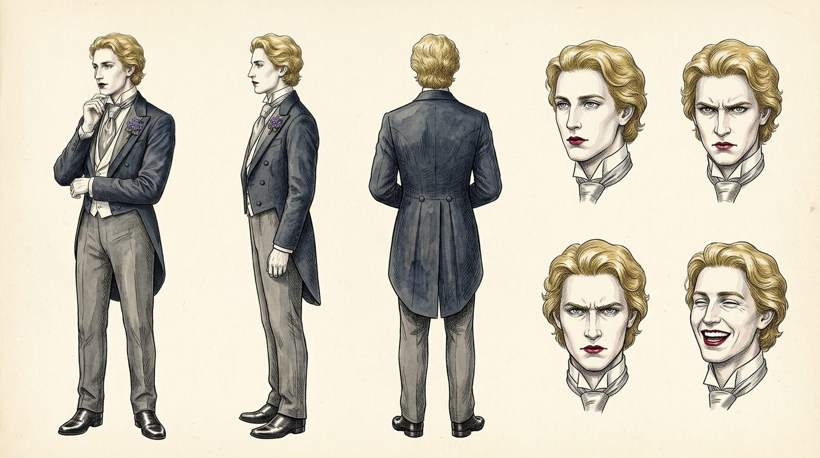
Reference sheet
Film looks we will not copy
- Hurd Hatfield 1945 film look
- Ben Barnes 2009 film look
- Penny Dreadful TV look
Always book accurate. Every quote above was checked word for word against our stored copy of the text. Pictures are made with AI from the book's own description and checked by hand for film looks.