Don Quixote 🔒 Members
Translated classics. From Don Quixote, Miguel de Cervantes (1605), John Ormsby translation (1885). A Spanish gentleman of about fifty, driven mad by reading books of chivalry, who believes himself a knight-errant and travels the world seeking adventures to win fame and serve his imagined lady Dulcinea.
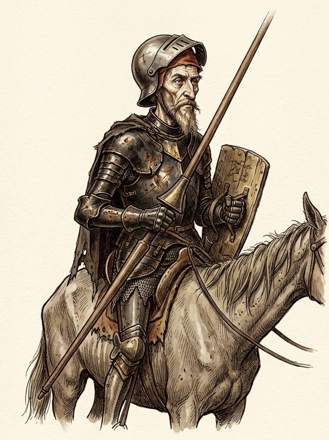
Age and build
Lean and lanky in build
“there stood Don Quixote in his tight-fitting breeches and chamois doublet, lean, lanky, and long, with cheeks that seemed to be kissing each other inside” (Don Quixote, part 49)
Very long legs covered with hair
“his legs were very long and lean, covered with hair, and anything but clean” (Don Quixote, part 25)
Face and hair
Cheeks sunken inward
“with cheeks that seemed to be kissing each other inside” (Don Quixote, part 49)
Wears a greasy red cap
“on his head he had a little greasy red cap that belonged to the host” (Don Quixote, part 25)
Dress
Wears full armour constantly
“arrayed in full armour (for, as he often said, that was “his only gear, his only rest the fray,” and he never was without it for a moment” (Don Quixote, part 66)
Armour is old and black like mouldy bread
“a piece of bread as black and mouldy as his own armour” (Don Quixote, part 5)
Wears a helmet with beaver that lifts up
“having his helmet on and the beaver up, he could not with his own hands put anything into his mouth unless someone else placed it there” (Don Quixote, part 5)
Wears a shirt under his armour
“he said they might give the shirt to Sancho; and shutting himself in with him in a room where there was a sumptuous bed, he undressed and put on the shirt” (Don Quixote, part 49)
Voice and speech
Speaks in a hoarse, excited voice when addressing enemies
“in a hoarse, excited voice he exclaimed, “You who hide your faces, perhaps because you are not good subjects, pay attention and listen to what I am about to say to you” (Don Quixote, part 33)
Speaks in low, tender voice to women
“he went on to say in low, tender voice” (Don Quixote, part 12)
Speaks with gravity and dignity
“Don Quixote replied with much gravity and dignity” (Don Quixote, part 9)
Uses elaborate, courteous language
“replied to him in words no less courteous” (Don Quixote, part 65)
Signature words
Refers to himself as 'Don Quixote of La Mancha'
“I am Don Quixote of La Mancha, against whom your evil machinations avail not nor have any power” (Don Quixote, part 57)
Calls his lady 'Dulcinea del Toboso'
“her name is Dulcinea, her country El Toboso, a village of La Mancha” (Don Quixote, part 10)
Uses 'fair lady' or 'fair ladies' in address
“In truth, fair ladies, I am well content to do what ye ask of me” (Don Quixote, part 9)
Refers to himself as a knight-errant
“I am a knight-errant” (Don Quixote, part 31)
Invokes enchantment as explanation for contradictions
“it is but ten hours since these said enchanters his enemies transformed the shape and person of the fair Dulcinea del Toboso into a foul and mean village lass” (Don Quixote, part 41)
Addresses people as 'señor' or 'señora' with courtesy
“Believe me, fair lady, you may call yourself fortunate in having in this castle of yours sheltered my person” (Don Quixote, part 12)
Gait and mannerisms
Rides his horse Rocinante at a canter, never galloping
“at a full canter (for in all this veracious history we never read of Rocinante fairly galloping) set off to encounter the penitents” (Don Quixote, part 33)
Folds his arms and bows his head when defenceless
“he thought it best therefore to fold his arms and bow his head and reserve himself for a more favourable occasion and opportunity” (Don Quixote, part 64)
Makes profound obeisances to nobility
“Don Quixote and Sancho rose and made them a profound obeisance” (Don Quixote, part 67)
Strengths
Possesses great physical strength in combat
“grasping his sword more firmly with both hands, he came down on the Biscayan with such fury, smiting him full over the cushion and over the head, that—even so good a shield proving useless—as if a mountain had fallen on him, he began to bleed from nose, mouth, and ears” (Don Quixote, part 9)
Shows courage and willingness to face danger
“with a spirit prepared to face any danger, he planted himself in front of the cart, and in a loud and menacing tone, exclaimed” (Don Quixote, part 39)
Demonstrates courtesy and politeness to all
“replied to him in words no less courteous” (Don Quixote, part 65)
Shows patience and restraint in difficult situations
“all which he bore with patience rather than sever the ribbons of his helmet” (Don Quixote, part 5)
Flaws
Driven mad by reading books of chivalry
“Good God! Who is there that could properly describe the rage that filled the heart of our Manchegan when he saw himself dealt with in this fashion” (Don Quixote, part 9)
Sees adventures and enchantments where none exist
“Don Quixote when he saw the strange garb of the penitents, without reflecting how often he had seen it before, took it into his head that this was a case of adventure” (Don Quixote, part 33)
Completely blind to reality regarding Dulcinea
“so great was the poor gentleman’s blindness that neither touch, nor smell, nor anything else about the good lass that would have made any but a carrier vomit, were enough to undeceive him” (Don Quixote, part 12)
Prone to violent outbursts when insulted
“You lie like a rascally clown,” returned Don Quixote; and lifting his pike, which he had never let out of his hand, he delivered such a blow at his head” (Don Quixote, part 31)
Obsessed with his imaginary lady Dulcinea
“I cannot say positively whether my sweet enemy is pleased or not that the world should know I serve her” (Don Quixote, part 10)
Traits
Believes himself a knight-errant bound by chivalric code
“I am a knight-errant” (Don Quixote, part 31)
Devoted to serving his imagined lady Dulcinea
“her name is Dulcinea, her country El Toboso, a village of La Mancha, her rank must be at least that of a princess, since she is my queen and lady” (Don Quixote, part 10)
Interprets all events through lens of chivalric romance
“his imagination was so wrought upon by the adventure he was going to accomplish, that it made him dream he had already reached the kingdom of Micomicon” (Don Quixote, part 25)
Maintains dignity and composure despite ridicule
“Don Quixote stood looking on very calmly” (Don Quixote, part 9)
Shows genuine concern for the distressed and wronged
“I take it upon myself. Give me my horse and arms, and wait for me here; I will go in quest of this knight, and dead or alive I will make him keep his word plighted to so great beauty” (Don Quixote, part 64)
Lines in their own words
On his lady Dulcinea's superhuman beauty
“for her hairs are gold, her forehead Elysian fields, her eyebrows rainbows, her eyes suns, her cheeks roses, her lips coral, her teeth pearls, her neck alabaster, her bosom marble, her hands ivory, her fairness snow” (Don Quixote, part 10)
On his identity and invulnerability
“I am Don Quixote of La Mancha, against whom your evil machinations avail not nor have any power” (Don Quixote, part 57)
On his readiness for battle
“Now, come who will, here am I, ready to try conclusions with Satan himself in person” (Don Quixote, part 42)
On his commitment to his quest despite hardship
“I will make the same to take no rest, and to roam the seven regions of the earth more thoroughly than the Infante Don Pedro of Portugal ever roamed them, until I have disenchanted her” (Don Quixote, part 46)
Reference sheet
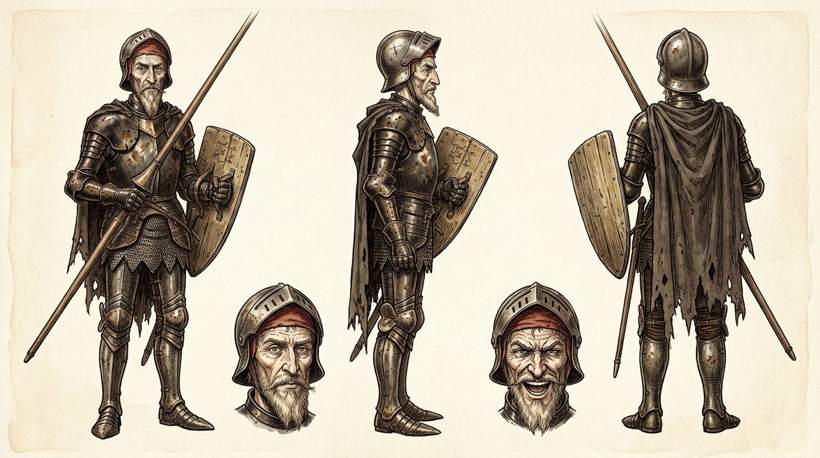
Film looks we will not copy
- Peter O'Toole Man of La Mancha film look
- Musical stage designs
- Picasso's 1955 sketch, still in copyright
- Gustave Doré poses copied line for line
Always book accurate. Every quote above was checked word for word against our stored copy of the text. Pictures are made with AI from the book's own description and checked by hand for film looks.