Athena 🔒 Members
Gods and heroes. From The Odyssey and The Iliad, Homer, Samuel Butler translations (1900, 1898). Minerva is the grey-eyed goddess of wisdom, warfare, and crafts who actively intervenes in mortal affairs to protect her favoured heroes and advance her purposes.
Care note: Text: Samuel Butler died 1902. Butler uses the Roman name Minerva.
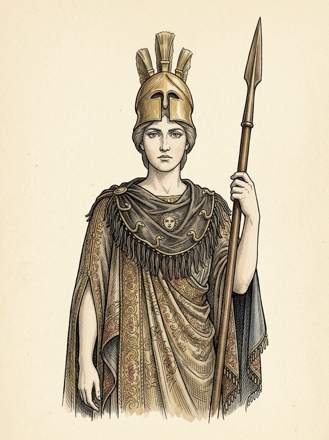
Age and build
The book is silent here, so we keep this plain and neutral.
Face and hair
grey eyes
“the grey-eyed goddess had kindled above the head of the great son of Peleus” (Iliad Butler, part 15)
Dress
richly embroidered vesture made with her own hands
“Minerva flung her richly embroidered vesture, made with her own hands, on to her father’s threshold” (Iliad Butler, part 5)
shirt of Jove
“donned the shirt of Jove, arming herself for battle” (Iliad Butler, part 5)
tasselled aegis with Rout, Strife, Strength, and Panic, and the head of Gorgon
“She threw her tasselled aegis about her shoulders, wreathed round with Rout as with a fringe, and on it were Strife, and Strength, and Panic whose blood runs cold; moreover there was the head of the dread monster Gorgon, grim and awful to behold” (Iliad Butler, part 5)
helmet of gold with four plumes and emblems of a hundred cities
“On her head she set her helmet of gold, with four plumes, and coming to a peak both in front and behind—decked with the emblems of a hundred cities” (Iliad Butler, part 5)
flaming chariot
“she stepped into her flaming chariot and grasped the spear, so stout and sturdy and strong” (Iliad Butler, part 5)
gold lamp shedding soft and brilliant radiance
“Minerva went before them with a gold lamp in her hand that shed a soft and brilliant radiance” (Odyssey Butler, part 14)
Voice and speech
voice of Mentor when appearing in disguise
“Minerva came close up to him in the likeness and with the voice of Mentor” (Odyssey Butler, part 2)
brazen voice that spreads terror
“Minerva also raised her voice from afar, and spread terror unspeakable among the Trojans. Ringing as the note of a trumpet that sounds alarm then the foe is at the gates of a city, even so brazen was the voice” (Iliad Butler, part 15)
Signature words
daughter of aegis-bearing Jove
“daughter of aegis-bearing Jove” (Iliad Butler, part 5)
grey-eyed goddess
“the grey-eyed goddess” (Iliad Butler, part 15)
goddess of wisdom and warfare
“I for diplomacy and subtlety have no equal among the gods” (Odyssey Butler, part 10)
Gait and mannerisms
darts swiftly from Olympus to intervene
“Down she darted from the topmost summits of Olympus, and in a moment she was at the ships of the Achaeans” (Iliad Butler, part 2)
assumes the form and voice of mortals
“Minerva took the form of Laodocus, son of Antenor, and went through the ranks of the Trojans” (Iliad Butler, part 4)
laughs and vaunts over defeated foes
“Minerva laughed and vaunted over him saying, “Idiot, have you not learned how far stronger I am than you” (Iliad Butler, part 17)
Strengths
supreme wisdom and counsel
“you are the most accomplished counsellor and orator among all mankind, while I for diplomacy and subtlety have no equal among the gods” (Odyssey Butler, part 10)
grants strength and courage to favoured heroes
“I have set in your heart the spirit of your knightly father Tydeus. Moreover, I have withdrawn the veil from your eyes, that you know gods and men apart” (Iliad Butler, part 4)
superior in combat to other gods
“With this she struck Mars on the neck, and brought him down. Nine roods did he cover in his fall” (Iliad Butler, part 17)
can transform appearance and voice
“Then she took the form of a woman, fair, stately, and wise” (Odyssey Butler, part 10)
endows mortals with divine comeliness
“Minerva endowed him with a presence of such divine comeliness that all marvelled at him as he went by” (Odyssey Butler, part 13)
Flaws
furious passion against her father Jove when thwarted
“Minerva sat silent without a word, for she was in a furious passion and bitterly incensed against her father” (Iliad Butler, part 7)
uses cunning deception to manipulate mortals
“Thus did Minerva inveigle him by her cunning” (Iliad Butler, part 17)
shows spite and malice toward those who displease her
“Minerva went up to Ulysses and prompted him to beg pieces of bread from each one of the suitors, that he might see what kind of people they were, and tell the good from the bad; but come what might she was not going to save a single one of them” (Odyssey Butler, part 13)
holds grudges and remembers past slights
“He forgets how often I saved his son when he was worn out by the labours Eurystheus had laid on him” (Iliad Butler, part 7)
Traits
protector of heroes and cities
“who have been ever with you, who kept watch over you in all your troubles” (Odyssey Butler, part 10)
favours the Achaeans over Trojans
“never would we shield Trojans from destruction, not even when all Troy is burning in the flames that the Achaeans shall kindle” (Iliad Butler, part 16)
Lines in their own words
encouraging Telemachus
“if you are made of the same stuff as your father you will be neither fool nor coward henceforward” (Odyssey Butler, part 2)
instructing Diomed in battle
“Fear not, Diomed, to do battle with the Trojans, for I have set in your heart the spirit of your knightly father Tydeus” (Iliad Butler, part 4)
vaunting over Mars
“Idiot, have you not learned how far stronger I am than you, but you must still match yourself against me” (Iliad Butler, part 17)
Reference sheet
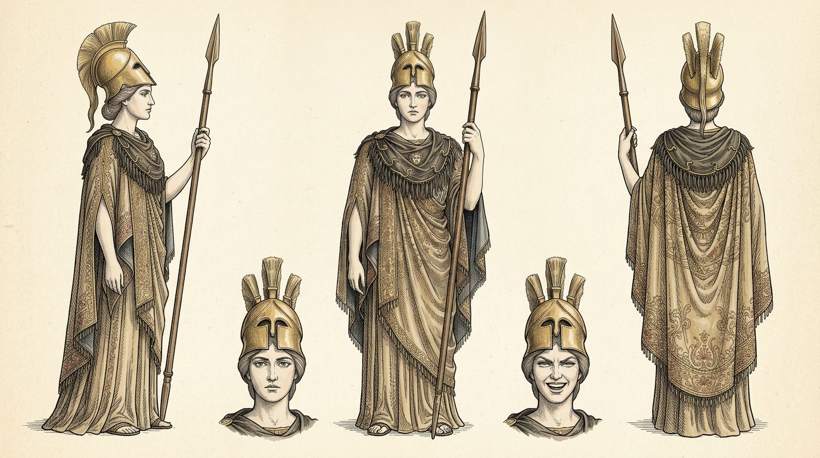
Film looks we will not copy
- Percy Jackson film or book designs
- Wonder Woman or any comic styling
- Video game designs
- Disney Hercules styling
Always book accurate. Every quote above was checked word for word against our stored copy of the text. Pictures are made with AI from the book's own description and checked by hand for film looks.